lecturer in digital media and culture at the University of Manchester, UK.

sam.hind@manchester.ac.uk

Tag: The Semaphore Line

  • Tweets and the Streets

    Another event happening today that I would’ve loved to have attended is a lecture by Paulo Gerbaudo entitled ‘Tweets and the Streets: Social Media and Contemporary Activism’ at the London College of Communication. It’s from 5-6.00pm. The lecture will be presenting ‘key themes and conclusions’ from his recent book of the same name. The lecture is hosted by the Spatial Communication Programme Group. Here is a little more from the LCC website:

    Gerbaudo will argue that activists’ use of Twitter and Facebook does not fit with the image of a ‘cyberspace’ detached from physical reality but that social media is used as part of a project of re-appropriation of public space, which involves the assembling of different groups around ‘occupied’ places such as Cairo’s Tahrir Square or New York’s Zuccotti Park. Tweets and the Streets points both to the creative possibilities and to the risks of political evanescence which new media brings to the contemporary protest experience.

    You can get hold of Gerbaudo’s introduction from Tweets and the Streets from his website here.

  • If you’re based in Manchester and looking for something to do, in 15 minutes (yeah, a little late notice) Richard Long is in conversation with Pavel Büchler at the Whitworth Art Gallery. If that’s a little too late, an exhibition of some of his work on ‘Land Art’ runs until 16th June.
    http://www.whitworth.manchester.ac.uk/whatson/exhibitions/richardlong/

    edwatts's avatarWhitworth Adult Programme

    Images copyright Richard Long

    Join us for this talk where Richard Long will be in conversation with Pavel Büchler.

    One of Britain’s most well-known artists, Richard Long established his international reputation in the 1970s with sculptures made as the result of epic walks. From 16 February two of his stone sculptures, White Onyx Line and Tideless Stones, will be shown alongside text works in our gallery.

    Richard Long emphatically changed the artist’s view from that of observing the landscape to journeying through it when he made his 1967 work A Line Made by Walking. Among such artists as Robert Smithson, Walter de Maria, and Nancy Holt, Long was at the centre of the Land Art movement. Since then, the artist has made sculptures during his many walks, the art being inseparable from his movement through the landscape. Two stone sculptures are shown at the Whitworth, White Onyx…

    View original post 55 more words

  • Stuart Elden links to a review of Thomas Nail’s Returning to Revolution (2012). Worth reading alongside some of Nicholas Tampio’s work on Deleuze and revolution too.

    stuartelden's avatarProgressive Geographies

    Thomas Nail’s Returning to Revolution: Deleuze, Guattari and Zapatismois reviewed at NDPR.

    NailWe are witnessing the return of political revolution. However, this is not a return to the classical forms of revolution: the capture of the state, the political representation of the party, the centrality of the proletariat or the leadership of the vanguard. After the failure of such tactics over the last century, revolutionary strategy is now headed in an entirely new direction. This book argues that Deleuze, Guattari and the Zapatistas are at the theoretical and practical heart of this new direction. Returning to Revolution is the first full-length book devoted to Deleuze and Guattari’s concept of revolution and to their connection with Zapatismo.

    The first 50 pages of the book can be downloaded for free.

    View original post

  • Railways, ticketing and digital technology

    The second article is from BBC Radio 4’s From Our Own Correspondent on the implementation of a new ticketing system on the Swiss railways. People in the UK will be familiar with a general diversification in ticket purchasing over the last few years, and you can typically buy in advance online or via smart phones. This alongside the traditional methods of both purchasing tickets at the station and on the train itself. However, the latter method has been abolished in Switzerland, which has led to some annoyances. Imogen Foulkes who writes the article gives three examples of the resulting confusion:

    Take, for example, the young man with a ticket which must be date-stamped by a machine on the platform. The machine is out of order, so he carefully writes in the date by hand, gets on board, and is fined by the conductor for not having a valid ticket.

    There is the pensioner, out for a day with his grandson, who kindly bought both their tickets on his mobile phone, but it turns out you are only allowed one e-ticket per person, so poor old granddad is fined.

    And then, there is me. One frosty morning I arrived at my local station to find that the ticket machine was broken. No matter, I thought, I have got a smartphone, and I hurriedly set about buying my ticket that way.

    In her own personal example she discovers a significant set of obstacles:

    This was not as easy as I had hoped, fiddling between credit card and phone with freezing cold fingers, but, by the time I got on the intercity to Geneva I had an e-ticket and I proudly showed it to the conductor.

    Unfortunately she was less than impressed and told me in no uncertain terms that my ticket was not valid. Why, only became clear several weeks later when a letter arrived from Swiss railways euphemistically named “revenue protection service”.

    The good people there tell me the formal payment for my ticket from my credit card company arrived four minutes after my train left the station. That means, they say, that I bought my ticket on the train – and that is not allowed.

    So, in using a mobile device to purchase her ticket she sidestepped the queues at the station – a reason many people are late for trains, and a general annoyance for all. But in doing so she also shifted the work of finding and paying of it back to herself from any clerk or collector. Coupled with the rather chilly Swiss weather, this wasn’t – it seems – a particularly easy task to perform. After being left to ponder why her ticket was invalid, she finally discovers that due to a delay in the processing of the payment her ticket was technically bought after the train had left the station. The administrative inference being that she had bought the ticket on the train (although actually impossible). Although Foulkes doesn’t go into the details I’d guess there was an issue with having a ticket for a specific train (the 11.10 rather than than 11.23) and that there was a price difference between the two. Thus she was ‘cheating the system’ by buying a cheaper ticket for the later train than the one she was travelling on. In effect then, she was travelling on the train without the correct ticket and thus liable to be fined the rather extortionate amount of 190 Swiss Francs (£133!).

    The reason why I found it interesting was two-fold. Firstly, it was her use of a mobile device to purchase a ticket. Secondly, it was a technological delay outside of Foulke’s control that created a very real and financially problematic effect. Both point to the distributed mechanics and agency of everyday mobility. Would it be at all within Foulke’s rights to blame her debit card processor for the fine she received? Presumably Swiss Federal Railways would require evidence for this delay. But how would she provide evidence for this? Could she contact her card processor and trace the temporal  actions of her ticket purchase? Say, by linking the exact time she pressed specific icons (‘conclude payment’, ‘confirm purchase’ etc.) to the time it took for her to receive her e-ticket. Presumably most payments process within a certain timeframe (4-5 seconds?) – so what if her’s took longer than expected? Where would the liability lie? At the door of the card processing company? Swiss Federal Railways for commissioning a clunky ticket application? Or the software company who coded it? Or, of course, with Foulkes and similar train passengers, who in her own words have simply ‘done their best to buy a ticket’.

  • I won’t apologise

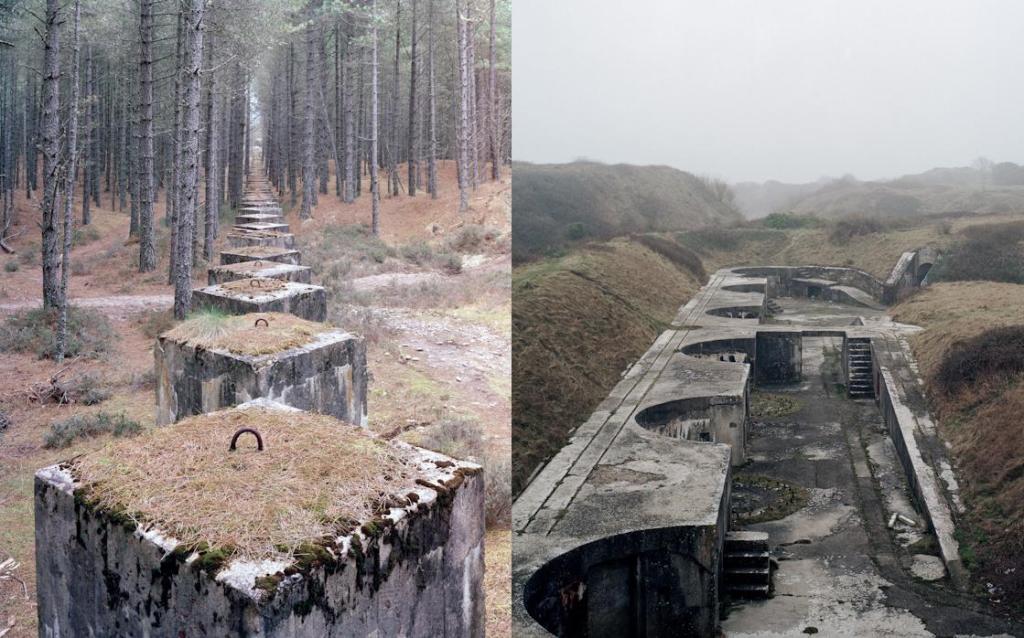
    for posting two BBC magazine articles this morning. Both are really fascinating. The first is by picture editor Phil Coomes on the work of  Marc Wilson who has been photographing the remnants of the UK’s WWII coastal defence network. Titled ‘The Last Stand’, Wilson’s work has taken him through Dorset, Suffolk, Aberdeenshire and Moray to name but a few places, as well as across the Channel to Northern France and Belgium, with further shooting due in Orkney, Denmark and Western France. In his own words:

    “This large body of work came out of a project I photographed about six years ago that included in its locations two of these coastal defences,” says Wilson. “From this my interest was sparked and further research into the subject matter in 2010 led me to realise the importance of producing this work, both as a document to the physical structures and their place in the shifting landscapes surrounding them, and as a stimulus for thought and reflection on the histories, and memories of these places.

    “Underlying all of this, and shared by many others I am sure, are also my own connections to this period of history and its effects on individuals, families and whole cultures.”

    There’s bound to be some work by geographers on these ghostly structures, and there is plenty of literature on France’s Maginot Line too. If anyone has anything particularly interesting on either I’d love to read it.

    The Last Stand

    The photos above were taken by Marc Wilson in Loussiemouth, Moray, Scotland (left) and Portland, Dorset , England (right) both in 2011.