
First sighting of nowhereisland: http://www.bbc.co.uk/news/uk-england-18894755. For more, click here.
Category: Space
-
2.8 Hours Later
Like zombies? How about real-world multiplayer games? And how about apocalyptic narratives like those seen in the film 28 days later?
Coming to a UK city near you soon, it seems. This city-wide ‘zombie chase game’ (at only £24 a pop!) challenges participants to negotiate the half-dead world, racing from bolt-holed survivor to bolt-holed survivor. All in the hope of reaching the zombie disco on your successful completion. That is, of course, if you avoid exposure to ‘zombie gore’…
-
Touching Space, Placing Touch
 Mark Paterson’s edited title Touching Space, Placing Touch with Martin Dodge is to see print this August. Ashgate’s page on the book is here, and includes an eclectic mix of touch-based spatial narratives.
French geographer Anne Volvey’s chapter ‘Fieldwork: how to get in(to) touch’ and Hannah Macpherson’s ‘Guiding visually impaired walking groups’ are of particular interest, and all chapters engage with topics otherwise neglected, or dealt with through standard visual approaches (art, toilets and elephant captivity as themes!).
I’ve tried my best to track down Paterson’s The Senses of Touch: Haptics, Affects and Technologies (2007), a fantastic historical analysis of touch. Chapter 5 entitled ‘Tangible Play, Prosthetic Performance’ sounds promising, and from reading some of Paterson’s other work in Human Geography journals, I’m convinced he’s got some approaches that might well tessellate with a Stieglerian approach. I also notice his PhD supervisor was Nigel Thrift, so there’s a definite link. His blog Senses of Touch is worth heading over too, with Haptic, Blindness and Technology the fulcrum of his research interest.
-
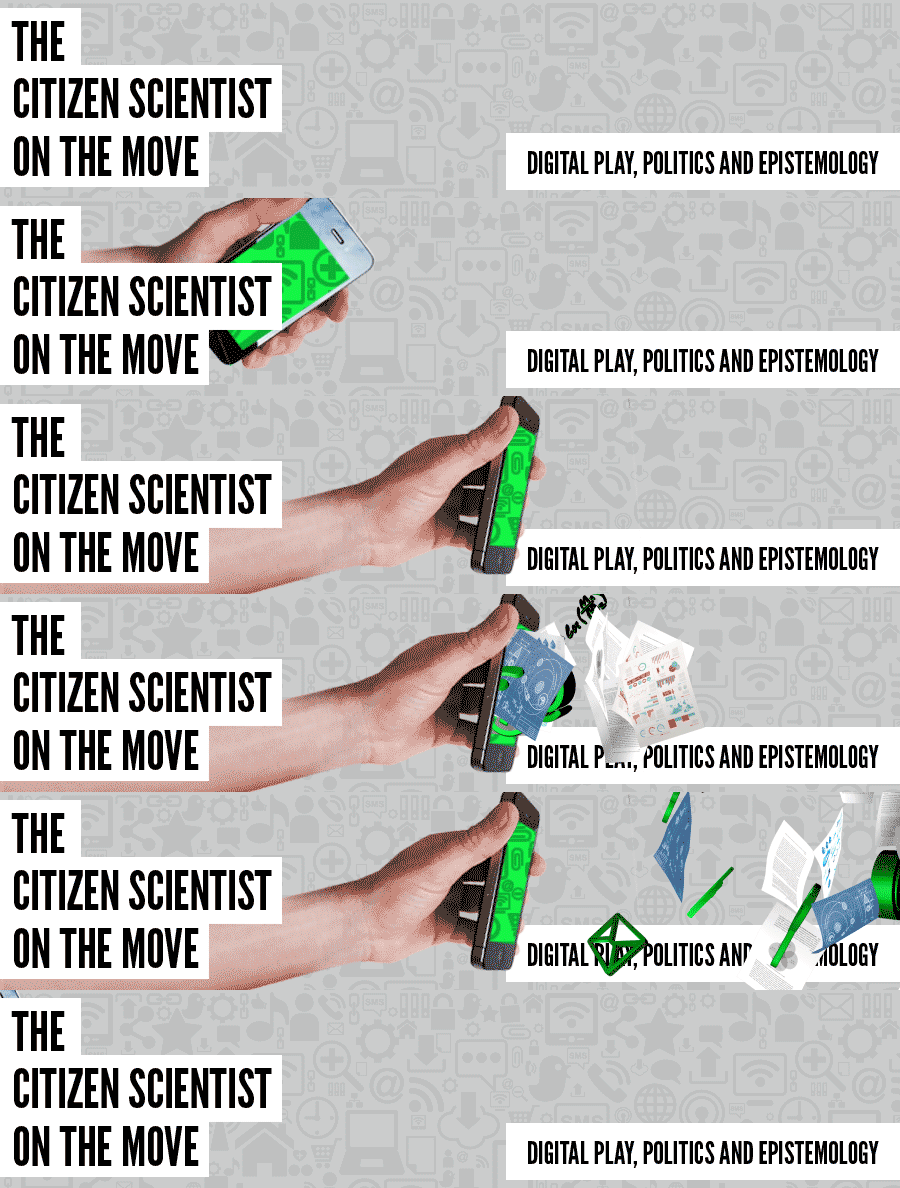
Digital Play, Politics and Epistemology
 Good looking conference at Utrecht University courtesy of the Centre for the Study of Digital Games and Play, 7Scenes and the Waag Society. Here’s what the organizers have to say about it:
With the advent of digital and mobile technologies scientific knowledge production has changed profoundly. As interactive, affordable, networked and ubiquitous technologies they invite people to engage with, alter and probe scientific ‘facts’. Play is essential to think about this new kind of engagement with science. It offers citizens powerful ways to become involved with and knowledgeable about scientific practices and offers subversive and exciting possibilities to actively contribute to and transform them. During this conference we therefore want to look at current citizen science developments through the lens of play. We will explore how the playful potential of digital media and cultures strengthen citizen’s scientific engagement and knowledge about their environment; and how the relationship between professional and laymen knowledge production is shifting through the ludic use of digital technologies.
Although the conference is invitation only for the first two days (25/26th June) there is an open public event on the 27th in Amsterdam featuring keynotes from, amongst others, Jeffrey Warren.
-
Le Havre

Went to see Finnish director Aki Kaurismäki’s latest film Le Havre earlier this week; a heart-warming story of a young African migrant and a shoeshiner in the French port of Le Havre.
Although unfamiliar with Kaurismäki, his film displayed a similar aesthetic to the work of Sylvain Chomet (Belleville Rendez-vous, The Illusionist), despite not sharing that lusty, frantic animated touch of Chomet’s feature films. Without revealing too much of the storyline, the lead character – Marcel Marx – is a struggling boot polisher and former Parisian bohemian. Upon stumbling across a young escapee from a failed asylum attempt (Idrissa), Marx proceeds to care for the boy. But with the story hitting city-wide headlines, local police detective Monet follows their every move. Melancholic characters (Marx’s partner Arletty, fellow shoeshiner Chang), juicy cinematography and dry comic exchanges make for a fluid feature-length. Upon discovering Idrissa has a remaining family member in the UK, Marx commits himself to finding the money needed for their reunion. With Arletty in hospital with cancer, Marx puts on a charity gig with Le Havre rock legend Little Bob; stumping up the money for his supposedly safe (but nonetheless illegal) passage across the Atlantic from fishing trawler to fishing trawler. Snopping Monet tips Marx off when it matters; Idrissa is presumed to have made his journey with success, and Arletty overcomes her illness.
Having watched last night’s Newsnight with a short piece on the French election, this film is released at a rather sensitive time. After the shootings in Toulouse; an event exposing the somewhat fractious political state in the country, Kaurismäki has succeeded in distilling some distinctly universal themes in national politics; namely those of citizenship, borders, and (illegal) asylum. It was of little coincidence Kaurismäki chose the port of Le Havre; depicted as a gritty, working-class city defined through it’s close network of work/drink relationships played out against an equally cinematic/metronomic background of daily coastal life. The sensitive, selfless nature of Kaurismäki’s lead character, Marx, make for a subtle rebuttal to those that recklessly stoke patriotic pride in the face of genuine humanitarian action. The film explores the warming nature of the latter against the mindless naivety of the former.
 Sam Hind