lecturer in digital media and culture at the University of Manchester, UK.

sam.hind@manchester.ac.uk

Tag: Politics

  • ontological ‘is’ and political ‘ought’

    Can a distinction between ontological existence (‘is’) and political desires (‘oughts’) be bracketed apart and hence exist as separate concepts? Levi Bryant thinks so over at his blog Larval Subjects, and it’s proven to be a sticky argument over at Alexander Galloway’s facebook page (pretty much a public one here – he comments on a lot of things). I don’t know whether this is indicative of SR’s reputation of the philosophy for the digital era, but Ian Bogost then summarises the lively debate over at his blog in a post entitled ‘Let’s talk about politics and ontology again!’. If you’re still keeping up, Bryant then responds in another post (‘War Machines and Military Logistics’) at Larval Subjects, and Harman jumps in with a short post over at his OOP blog here.

    If this is all a bit tl;dr, then let me summarise some key points to the argument. Bryant suggests, in short, that whilst ontologies can indeed be produced through political means (say, in the form of ideological bias), they are in themselves apolitical as they concern ‘being’ (or ‘what is’) ipso facto are factual concerns. He (says he) makes no claims to an idealized or preferred state of things in this passage (an ‘ought’ rather than an ‘is’).

    In a relational form, then:

    ontology/ies (‘is’) ——–> politics (‘ought’)

    His critics in the fb post on Galloway’s wall, again, in summary, suggest that by making this claim of a partitioned apolitical ontology, he is in fact making a distinctly political claim. In the process one of the commenter’s charge him and other SRs with having a ‘depoliticizing stab at a new realism’ (see Jairus Grove’s first post).

    Imho, I think the people who are responding to Bryant on Galloway’s page are making a few cheap shots, and Bryant himself actually underplays the construction of ontology which might have helped in get away from the criticisms angled at his approach to ontological and political separation. I probably agree on the points made by Grove especially, but argue that this doesn’t necessary detract from SR/OOO’s aims. I think Bryant would do well to accept the political nature of ontological claims (notice the small p) but be happy in refuting the Politics of ontology (with a capital p) on the basis of needing to act on a broader, transindividual plane that works with some (more?) solid claims (immutable mobiles, say?), i.e. an ontological basis. So it’s whether you give credence to the solidity of ontological claims as being ‘true’ as to whether or not you can agree with Bryant on this one.
     

  • Battle For the Internet

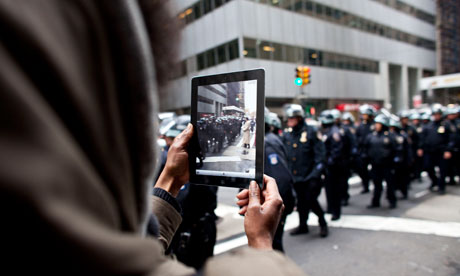
    The Guardian have been running a series all week entitled; ‘Battle for the internet‘, taking a look at the new frontiers of the web. So far the most interesting article posted in the series focused on ‘walled gardens’ – closed computer hardware (mainly Apple’s new stable of mobile products) with restricted operability. That is, a growing range of devices such as the iPad that limit user ability to dig down into code, run non-authorised software, or curate their own, self-verified programs.

    The fulcrum of the piece was the antagonism between ‘generative’ devices (those that can be programmed to do more than they were set-up to do) and ‘reductive’ devices (as above, those that limit/deny programmability by the user). Mobile smartphones, by and large, fall into the latter category. Jonathan Zittrain‘s book The Future of the Internet and How to Stop It (2008) shapes this argument.

    The obvious question, then, if mobile smartphones are results of a ‘tethering’ process (Zittrain 2008) designed to limit program operability to those screened and sold through App stores or other similar marketplaces, is; why is this necessary? What do smartphone manufacturer’s have to gain from, in effect, reducing their product’s usability? And, does this reduce a product’s value?

    Of course, it’s easy to simply say this is a case of Apple (and others) wanting to profit from their own success. The brand itself has swollen in worth, even since the mid-noughties, and despite Steve Job’s death remains a technological powerhouse. It’s App Store – combined with its iPad – represents the frontier of it’s business currently. In securitizing the use of the latter through the former, Apple have bricked up large swathes of internet usage behind its rather menacing walls. In operating with such impunity, Apple have managed to attain a level of online policing unknown to, or uncharacteristic of Western democracies, and much more akin to online modus operandi of the Chinese Communist Party, Arab Socialist Ba’ath Party or Iranian Government. This – rather than mere profit – becomes a greater concern for global web usage.

    There’s also a great quote from journalist and author, John Battelle on the ‘unstoppable’ mobile nature of the web:

    “The PC-based HTML web is hopelessly behind mobile in any number of ways,” he [Battelle] wrote on his blog. “It has no eyes (camera), no ears (audio input), no sense of place (GPS/location data). Why would anyone want to invest in a web that’s deaf, dumb, blind, and stuck in one place?”

    Whilst the quote itself draws on the hapless PC to elucidate the absurdity of a ‘non-sensing’ platform (slow, clunky, vulnerable, flawed), on the whole, the article lauds it as some sort of biblical feature pre-dating the narrowed confines of web 2.0. Of course, this is doubly untrue. Firstly, the PC-based HTML web can indeed sense in all the noted ways. It still has eyes (web-cams), ears and a sense of place (however fixed and immobile).  And secondly, the continued investment in mobile technology (aka web 2.0) is predicated on open, expansive, experiences. Only Apple and other pretenders seem to gain from the walled garden effect. The challenge, like Zittrain notes, is to traverse these boundaries in ways that cast open the future of the web.

  • Le Havre

    Went to see Finnish director Aki Kaurismäki’s latest film Le Havre earlier this week; a heart-warming story of a young African migrant and a shoeshiner in the French port of Le Havre.

    Although unfamiliar with Kaurismäki, his film displayed a similar aesthetic to the work of Sylvain Chomet (Belleville Rendez-vous, The Illusionist), despite not sharing that lusty, frantic animated touch of Chomet’s  feature films. Without revealing too much of the storyline, the lead character – Marcel Marx – is a struggling boot polisher and former Parisian bohemian. Upon stumbling across a young escapee from a failed asylum attempt (Idrissa), Marx proceeds to care for the boy. But with the story hitting city-wide headlines, local police detective Monet follows their every move. Melancholic characters (Marx’s partner Arletty, fellow shoeshiner Chang), juicy cinematography and dry comic exchanges make for a fluid feature-length.  Upon discovering Idrissa has a remaining family member in the UK, Marx commits himself to finding the money needed for their reunion. With Arletty in hospital with cancer, Marx puts on a charity gig with Le Havre rock legend Little Bob; stumping up the money for his supposedly safe (but nonetheless illegal) passage across the Atlantic from fishing trawler to fishing trawler. Snopping Monet tips Marx off when it matters; Idrissa is presumed to have made his journey with success, and Arletty overcomes her illness.

    Having watched last night’s Newsnight with a short piece on the French election, this film is released at a rather sensitive time. After the shootings in Toulouse; an event exposing the somewhat fractious political state in the country,  Kaurismäki has succeeded in distilling some distinctly universal themes in national politics; namely those of citizenship, borders, and (illegal) asylum. It was of little coincidence Kaurismäki chose the port of Le Havre; depicted as a gritty, working-class city defined through it’s close network of work/drink relationships played out against an equally cinematic/metronomic background of daily coastal life. The sensitive, selfless nature of Kaurismäki’s lead character, Marx, make for a subtle rebuttal to those that recklessly stoke patriotic pride in the face of genuine humanitarian action. The film explores the warming nature of the latter against the mindless naivety of the former.    

  • Situated Technologies I

    “Si vous réussissez, vous serez bientôt couverts de gloire”
    (“If you succeed you will bask in glory”)
    The Chappe Brothers 1791

    The Semaphore System was an early mechanical informational device to send visual messages across long distances. In it’s initial guise, the semaphore system was devised by the Chappe Brothers to send coded messages from French military forces in the late 18th century. This blog takes it’s name from The Chappe Brother’s invention (synonymously known as a ‘Semaphore Line‘) , and the quote above comes from the first message sent between two signal towers in 1791.

     As a historical example of the nexus of military needs, political and revolutionary events, and visual informational devices, the Semaphore Line acts as a grounding for thinking through the dynamics of geospatial technology, interactive media and the digital frontier. This blog will collate some of the work done at the intersection of these fields.