
The future is just around the corner. Quite literally.
lecturer in digital media and culture at the University of Manchester, UK.

The future is just around the corner. Quite literally.
Ken Field has a new (open-access) editorial piece in the latest issue of The Cartographic Journal.
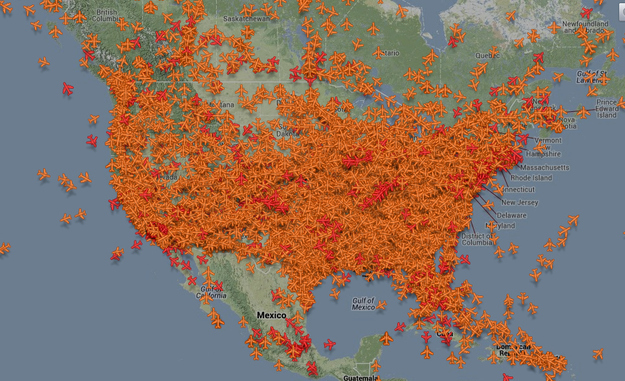
Entitled ‘A Cacophony of Cartography’, it is a rather delightful attack on internet map porn; those ‘awe-inspiring’ and ‘mind-boggling’ maps that amaze and intrigue in equal measure. You know the ones. Those that compare the size of things. Those that show our internet searching habits. Those that ‘reveal’ how much money is in sport. Those that ‘amaze’ us with all the planes in the sky before Thanksgiving. You know, the maps that show us everything and nothing at the same time. Ken uses the Amazing Maps Twitter account as an indicator of this crazy, lawless world.
Then, he looks to online – and mainly US-based – publications that have compiled lists of their favourite maps of the past year: Wired, Fast Company, Slate, Gizmodo, The Atlantic Cities and GIS Lounge. He critiques each list individually, suggesting that Wired‘s fails to live up to its self-titled ‘amazing’ billing. Fast Company‘s is cartographically weak. Slate‘s is just downright bizarre. Gizmodo‘s drills down to ’boutique’ datasets – but does so with ‘hideous errors’. The Atlantic‘s isn’t even a compilation of the new, whilst finally, GIS Lounge‘s is simply populist.
To this collection I would also add one important other, for I think it is this platform that perhaps has defined the nature of all these map lists in 2013, and that website is Buzzfeed. If you don’t know anything about Buzzfeed, let me explain. Buzzfeed do lists. Lots of them. Many purport to Blow Your Mind. Many more goad you into thinking you’re somehow Missing Out (On Life/This Week). It’s this Fear of Missing Out that drives the Buzzfeed platform. Oh, and the little bits of procrastination time in every office worker’s day. Whilst their usual fare is pop culture, they’re also keen on publishing lists of maps. Lists of maps that are either Missing From Your Life or You Never Knew You Needed.
Their own Most Interesting Maps of 2013 list is, well, not very interesting, really. Firstly, they’re exclusively US maps. So not very interesting if you happen to read Buzzfeed from anywhere else. One of them decides to show all the US national parks that stayed open during the government shutdown with odd little arrows and pictures. The content isn’t really that ‘interesting’ and it certainly isn’t something that might warrant inclusion in any Best Of list. One is about Blockbuster rental franchises (!) with its logo plonked onto a state-marked map with no other detail whatsoever. Again, is that really ‘interesting’ to anyone? One has a particularly garish colour palette that distracts from any interest at all, whilst one might have been interesting if they could’ve been bothered to colour the rest of the map in. The Thanksgiving map I mentioned above is probably the best because of its downright absurdity, but it still lacks the punch of the Bomb Sight platform that works on a similar premise; using a swarm of pushpins to show the intensity and widespread nature of the mapped content.
As Ken summarizes in reference to his own selection of ‘Best Of’ compilation:
Most of the maps are not innovative or new. Mostly the lists are compiled by non-cartographers (non-experts) so it’s questionable whether their view can be deemed authoritative in any sense. Some are simply regurgitating what’s been most viral during the year which is pretty lazy. (7)
In sum then, they amount to nothing more than cartographic clickbait designed to lull readers into thinking that, somehow, without these maps, their lives will be poorer. Despite what Steve Hind says in this CiF article from last year, we shouldn’t be defending clickbait content. That’s why XKCD published this comic on ’20th Century Headlines to Get More Clicks’, as Hind mentions. Reducing the world to one of shallow amazement and awe at the expense of critique and analysis not only reduces our exposure to a ‘vast wealth of cartographic riches’ (7) as Ken puts it, but also breeds a certain cartographic naivety. Whilst most of the maps presented in these lists are loosely attributable they are not necessarily stronger for it. We know neither how some of these maps are produced, nor what data they have been produced from. Further, we believe that these maps have no other reason to be created, other than for our earthly pleasures. Yes, the inclusion of McDonald’s Around the World or population density maps point to discussions of larger issues, but they, like many, are presented without context and reason; as mere lists to linger in the browser tabs of bored office workers. This is why I suggest that Buzzfeed leads the way, rather than Wired, Slate and the others discussed in Ken’s editorial. The clickbait titling X the default list format is a recipe for viral cartography. We should, therefore, be mindful of where we are heading.
Fundamentally, I don’t actually believe cartographers like Ken and the general public have totally differing desires here, despite what is claimed. OK, so your coders want the backend of their mapping platforms to function smoothly, your UI experts want the frontend to work ‘intuitively’, your cartographic designers want appropriate and pleasing projections, legends and hues, and your media moguls want hits for advertising revenue, but the public equally look for aesthetic and functional impact. I don’t, for example, share Ken’s view that we necessarily should be looking to ‘encourage a public to develop a better sense of quality, a better sense of cartographic taste…’ (7). It smacks, if I’m being honest, of paternalism; of ‘cartographers know best’. What we are perhaps better doing, is critiquing how and why sites like Buzzfeed choose and compile cartographic content; why they think they are ‘Must See’ maps. Although parody accounts such as zOMG Maps!!!1 are a great start in satirizing the proliferation of cartographic clickbait, even Gizmodo has managed to nullify this effort, rendering the concern as yet another excuse to publish just more of the same. We need instead to cast an analytical eye over the nature of online mapping. Only then will our Minds Be Truly Blown.

Next Tuesday will see the third seminar in the Living Maps series. After ‘Mapping the Field’ and ‘Hidden Histories’, ‘Grounding Knowledge’ will see Øyvind Eide, Iain Boal and David Pinder tackle issues of power and politics. I will be travelling down to London from Manchester for it myself.
Hosted this time at QMUL, the seminar will aim to interrogate the epistemological bases for mapping in the modern world. Questions such as “how are maps situated?”, “how do they tell specific stories?” and “how do they propose new ways of existence?” all pertinent.
Content from seminar’s ONE and TWO can also be viewed over at the Living Maps website. Tickets for each seminar are priced at £5 for students/unwaged and £20 for professionals/academics. They can be purchased individually from here. It will run from 18.00 – 20.30.
Completing a hat-trick of activism posts, I thought I’d embed a video of Sukey developer, electronic engineer, activist, hacker and maker (!) Samuel Carlisle speaking on ‘Disruptive technologies’ at the ThinkTwice conference. Hosted in Frankfurt by Pirate Parties International, it was an attempt to bridge the gaps in knowledge between PPI, academia and the NGO world. Its tagline was ‘Away from Keyboard’ so much of the content was centered on the the interplay between offline and online activism.
Samuel’s presentation itself was an attempt to talk about the fostering of a ‘read/write’ world in which individuals learn the ability to interrogate the ‘black-box’ nature of modern technological devices in order to engage in civic action. The details of the talk as well as his slides are available here.
 Sam Hind