Courtesy of Lighthouse.
And the making of Under the Shadow of the Drone for Brighton Festival:
lecturer in digital media and culture at the University of Manchester, UK.

Courtesy of Lighthouse.
And the making of Under the Shadow of the Drone for Brighton Festival:
The latest CRESC Newsletter has an article on page 6 by Francis Dodsworth and Sophie Watson on a collaborative project entitled ‘Mundane Objects in Public Space’. Here is a short excerpt discussing their focus:
“We aim, as a strategic device, at the smaller scale: encounters with the “little” objects of the street and how those objects are embedded, for better or worse, in the stream of everyday life. We stoop to the level of things like waste bins to learn how people use public objects. We want to study the reciprocal relations of city users and city things: how objects shape behavior and how behavior gives form to artifacts, as objects (sometimes at least) undergo physical change through use. Public space, both as social and physical accomplishment, gains part of its reality through these encounters.”
Following recent posts on Manchester and Salford here’s a link to a new Cultural Studies paper on ‘The Urbis Building as Looking Glass’ by Steve Hanson and Mark Rainey (subs. required). It uses the Urbis building in Manchester as a device for discussing wider social, cultural and economic changes taking place at a local and national level in the UK since the early 2000s. There’s also a short discussion of the mothballed Origin development site on Whitworth Street originally destined to be apartments, office space and a ’boutique hotel’. If you fancy a little dark humour, the optimistic signage that still remains on the perimeter fence (“Live, Relax, Work” – “Efficient, Effortless & Individual”) is always worth a look. Sums up the rise and fall of the urban construction boom in the UK, built exclusively on the hollow slogans above.
3. “Walk north until you find something forgotten. Or until you’re at ease.”
This final navigational prompt saw us walk along the Salford side of the River Irwell. Here I actually want to explore two opposing terms, ‘something forgotten’ and ‘something remembered’. The former put us both ‘at ease’ as the prompt suggested, whilst the latter did the opposite; putting us ‘ill at ease’.
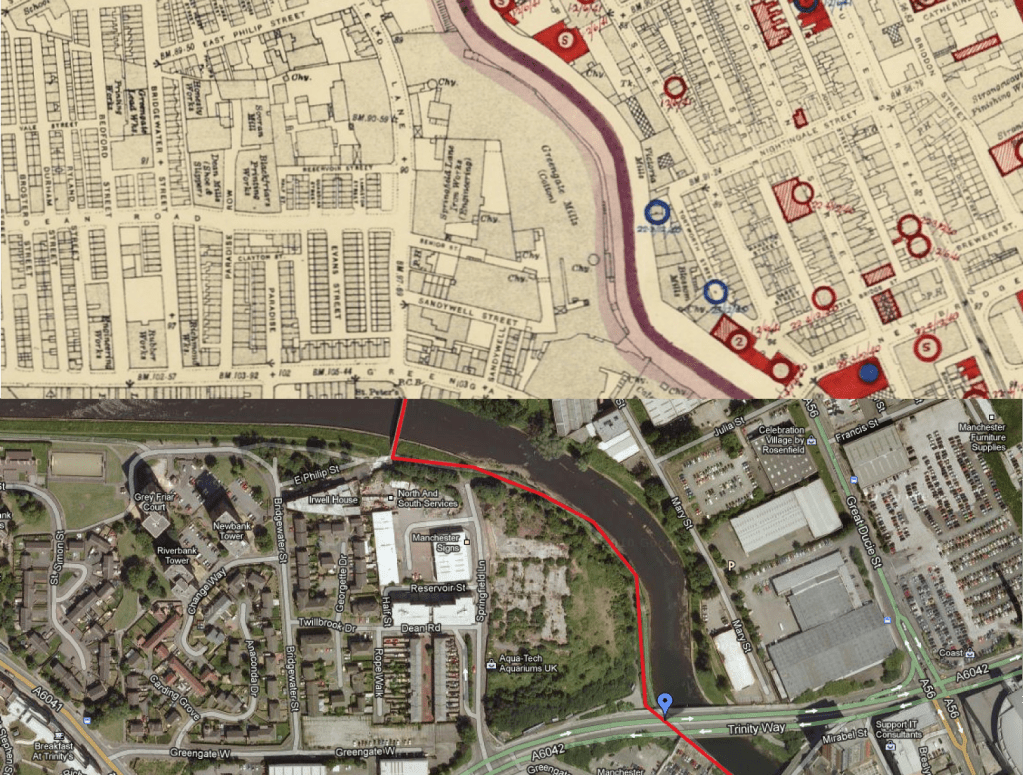
We decided to continue walking north up along the River Irwell and along a rather hidden walkway underneath the Trinity Way, the walls of which were clad with some beautiful green and white tiles. We then saw an uncharacteristically green segment of land nestled in between the river, Trinity Way and a row of houses. We were rather surprised, so hopped over a small bank and surveyed the area wondering as to it’s life story.
Only now, thanks to the same 1940 Bomb Map am I able to find out how it came to be: it was previously the site of Greengate Cotton Mill. Two years ago, with the help of the Environment Agency a set of stones carved with the name of the Mill were recovered from the River Irwell and placed on the riverbank. In the video above one of the individuals connected to the project says they are unsure of the exact location of the Mill because of the lack of historical maps of the area. Community website SalfordOnline followed the story at the time, and I’m unsure as to whether they know the 1940 Bomb Map clearly shows Greengate Mills in the patch of grass just downstream from where the stones were discovered. The maps themselves (they were stitched together) were only recently re-discovered and covered in the local press. At the time we were blissfully unaware of the history of this patch of land – and until recently it’s remarkable life story had remained forgotten.
After walking back over the river towards Cheetham Hill we couldn’t ignore the lure of heading towards Strangeways – that iconic Victorian-era prison. Holding both Category A and local remand prisoners, HM Prison Manchester is an imposing structure. Designed by Alfred Waterhouse in a style not too dissimilar from his other major city projects; Manchester Town Hall and St. Mary‘s Hospital, it is a well-known feature of the North Manchester skyline.
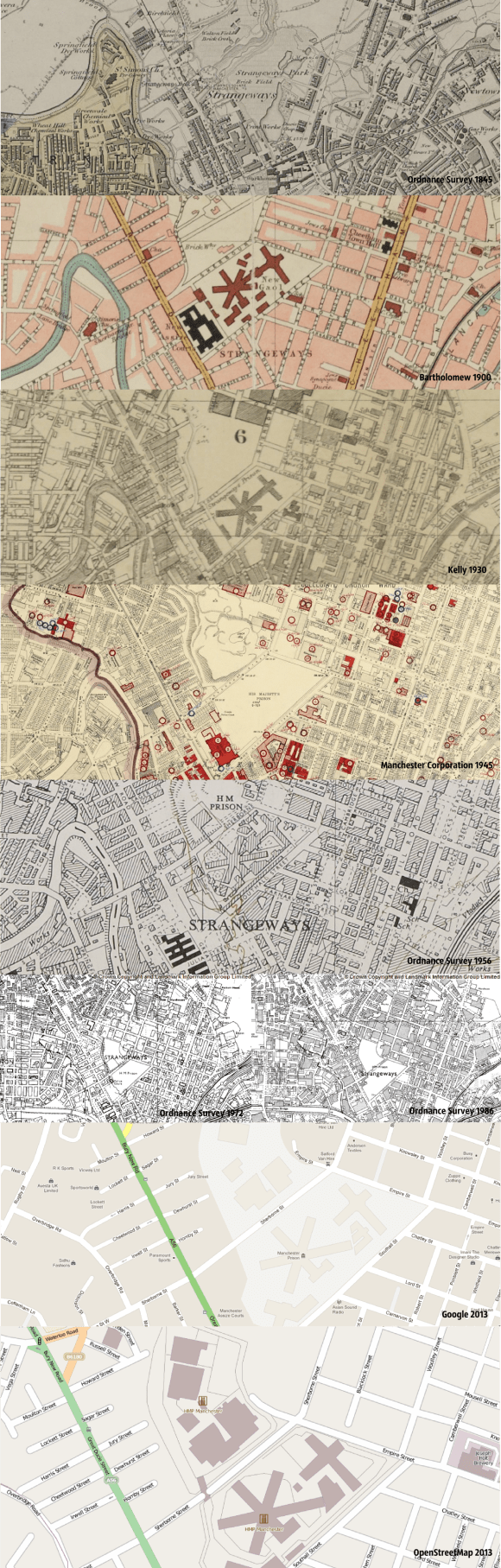
What is intriguing is that, like many sensitive Government sites, prisons have historically been excluded from publicly available maps. The Ordnance Survey, for example, have typically labelled Ministry of Defence sites as “Government Offices” (see: http://www.secret-bases.co.uk/secret.htm) and rather than depicting accurate outlines of buildings, they have only marked perimeter fences and boundary lines. Thanks to hi-res satellite imagery, it’s rather more difficult to keep out prying eyes – but there are still techniques used by mappers to hide spatial detail. Outdated and blurred imagery being the most obvious. Chris Perkins and Martin Dodge’s (2009) Geoforum paper (open access) is a fantastic read into this tension between cartography and counter-cartography.
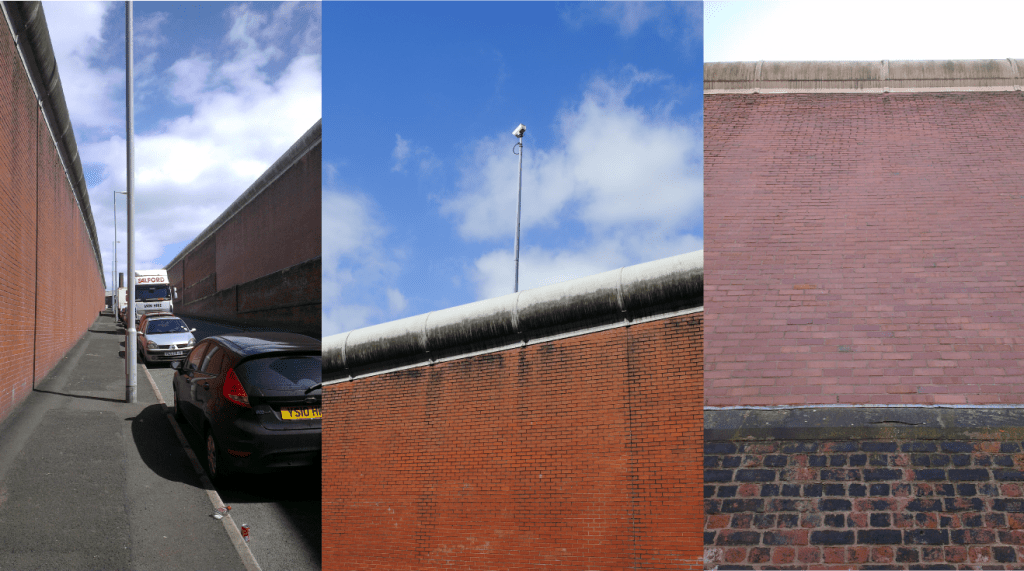 Strangeways provokes a distinct feeling of unease when approaching, especially when one walks along Sherborne Street between the two sides of the prison. Tall, flat walls along each side. A steep incline towards Exchange Street. Lone CCTV cameras the only thing visible over either boundary. There is little chance of escape for the incarcerated inside, and slim opportunity for those to break-in from outside.
So as a closing comment on this final uneasy stage of a drift across North Manchester I’ll finish with a series of maps of Strangeways through the years – spatial depictions of this curious Panopticon revealed to those outside through the power of the map.
 Sam Hind