lecturer in digital media and culture at the University of Manchester, UK.

sam.hind@manchester.ac.uk

Category: Politics

  • Serres on Tintin

    French philosopher Michel Serres on Tintin. If anyone could translate some of the key details please do get in touch UPDATE Terence Blake has kindly translated the video here – although from Serres’ body language and gesticulations I do get the feeling he’s a rather big “Tintinophile”.

    My undergraduate dissertation was a postcolonial reading of four Tintin titles – Tintin in the Congo, Land of Black Gold, King Ottokar’s Sceptre and Tintin and the Picaros – and I remain deeply interested in the cultural legacy of Hergé’s most famous series. My argument, which I continue to support now, was that Hergé’s treasured creation was deeply and inherently Colonialist, with all the racial, imperial and paternalistic connotations that came with it. Part of my attempt was to move beyond the official narrative that I believe has plagued common readings of the series so far; that the early overtly racist (Congo) and propagandist (Land of the Soviets) titles were simply the results of youthful folly under the tutorship of a Catholic abbot. I claimed that, throughout, Hergé had utilized his ligne claire style of drawing to create an allure of social truth, realism and objectivity, whilst ‘othering’ a whole host of characters from West Africa (in Congo), the Middle East (Arabs in Black Gold, Jews in The Shooting Star), South America (in Picaros) and Japan (in Blue Lotus).

    I was just discovering Said’s magisterial Orientalism (1978) and getting to grips with Derek Gregory’s incredible Geographical Imaginations (1994) and his later work on The Colonial Present (2004) so to say I was influenced by subaltern and postcolonial studies is putting it lightly. Other titles by James Ryan, Jason Dittmer, Thierry Groensteen, Catherine Lutz & Jane Collins were all massive influences on my reading of imperialism, geopolitics, bande dessinée and photography. I’ve uploaded the thesis to my about page if anyone is interested. All the aforementioned titles are referenced within.   

    Famously, Charles de Gaulle said Tintin was his only international threat, and Serres himself also declared Hergé to have had the “most impact on contemporary French life” of any author, ever. The irony of both these comments, of course, was that neither Hergé or Tintin were actually French themselves – both being proudly, yet perhaps indistinctly, Belgian.

    A new temporary exhibition on Tintin in India has launched this week at the Musée Hergé for those in the Brussels area too, and runs until January 2014. 
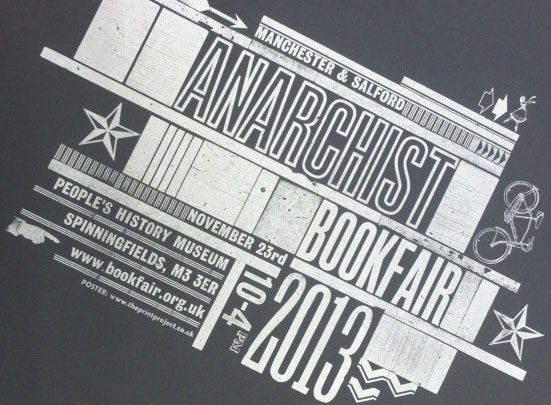
  • Manchester & Salford Anarchist Bookfair 2013

    1383229_319447664859728_1019128745_n

    At the People’s History Museum, Saturday 23rd November, 10am – 4pm. For more information, see here. Here’s a short selection of stalls that will be there on the day (click here for the complete list):

    Hand Job Zine
    http://handjobzine.wordpress.com

    We are a DIY literary zine that collects writing and illustration from around the UK, trying to give a voice to many people with opinions and beliefs that are shunned or undervalued by a lot of the mainstream literary journals and magazines. We present it as an anarchist zine, but as long as people have an interesting idea we will put it in there.

    Manchester Social Centre
    http://manchestersocialcentre.org.uk/
    https://www.facebook.com/ManchesterSocialCentre

    There has been a growing need for a radical community hub in the years since Manchester’s last social centre, The Basement, was closed due to flooding. Manchester Social Centre aims to fill this void by reclaiming space and services within the city and turning it into a ‘corporate free’ sanctuary for the community. We want to create a space for local activity and interaction, enabling groups to hold meetings and events at low cost, for members to share resources, develop and form links with other groups, and providing an accessible means for the people of Manchester to unite and share in positive radicalism.

    News From Nowhere
    http://www.newsfromnowhere.org.uk
    https://www.facebook.com/newsfromnowherebookshop
    39-year old Radical and Community Bookshop based in Liverpool. All subjects covered in a subversive way. A workers’ co-operative run by a women’s collective – shop with the real Amazons!

    STRIKE! Magazine
    http://www.strikemag.org
    STRIKE! is a radical, quarterly newspaper – we deal in politics, philosophy, art, subversion and sedition. Each issue we gather together a group of high-grade artists and authors, give them a theme, and let them get creative with it. It’s a magazine, it’s a journal, it’s a carnival.

  • KOCHUU (2006) and The Pruitt-Igoe Myth (2011)

    Back in January this year Arch Daily compiled a list of 30 must-see architecture documentaries. Most of their choices focused on specific architects, so Herzog & de Meuron, Gaudi, Eames, Foster, Loos, Koolhaus and Gehry are all covered. But there were two in particular on the list that stood out, partly because they drew inspiration from wider movements or urban environments to create their own narratives:

    KOCHUU: Japanese Architecture / Influence & Origin (2006) by Jasper Wachtmeister

    “…a visually stunning film about modern Japanese architecture, its roots in the Japanese tradition, and its impact on the Nordic building tradition. Winding its way through visions of the future and traditional concepts, nature and concrete, gardens and high-tech spaces, the film explains how contemporary Japanese architects strive to unite the ways of modern man with the old philosophies in astounding constructions.

    KOCHUU, which translates as “in the jar,” refers to the Japanese tradition of constructing small, enclosed physical spaces, which create the impression of a separate universe. The film illustrates key components of traditional Japanese architecture, such as reducing the distinction between outdoors and indoors, disrupting the symmetrical, building with wooden posts and beams rather than with walls, modular construction techniques, and its symbiotic relationship with water, light and nature.

    The film illustrates these concepts through remarkable views of the Imperial Katsura Palace, the Todai-Ji Temple, the Naoshima Contemporary Art Museum, the Sony Tower, numerous teahouses and gardens (see link below for complete list), as well as examples of the cross-fertilization evidenced in buildings throughout Scandinavia, and shows how ‘invisible’ Japanese traditions are evident even in modern, high-tech buildings.”

    and The Pruitt-Igoe Myth: An Urban History (2011) by Chad Freidrichs

    “It began as a housing marvel. Two decades later, it ended in rubble. But what happened to those caught in between? The Pruitt-Igoe Myth tells the story of the transformation of the American city in the decades after World War II, through the lens of the infamous Pruitt-Igoe housing development and the St. Louis residents who called it home.

    At the film’s historical center is an analysis of the massive impact of the national urban renewal program of the 1950s and 1960s, which prompted the process of mass suburbanization and emptied American cities of their residents, businesses, and industries. Those left behind in the city faced a destitute, rapidly de-industrializing St. Louis , parceled out to downtown interests and increasingly segregated by class and race. The residents of Pruitt-Igoe were among the hardest hit. Their gripping stories of survival, adaptation, and success are at the emotional heart of the film.

    The domestic turmoil wrought by punitive public welfare policies; the frustrating interactions with a paternalistic and cash-strapped Housing Authority; and the downward spiral of vacancy, vandalism and crime led to resident protest and action during the 1969 Rent Strike, the first in the history of public housing. And yet, despite this complex history, Pruitt-Igoe has often been stereotyped. The world-famous image of its implosion has helped to perpetuate a myth of failure, a failure that has been used to critique Modernist architecture, attack public assistance programs, and stigmatize public housing residents. The Pruitt-Igoe Myth seeks to set the historical record straight. To examine the interests involved in Pruitt-Igoe’s creation. To re-evaluate the rumors and the stigma. To implode the myth.”

  • A different sort of hell

    Derek Gregory on Joe Sacco’s stunning new title, a 24ft illustration entitled ‘The Great War: July 1, 1916’.

    The comparisons to Hergé are apt in this context, seeing as Hergé himself didn’t travel in the first instance to most of the places he depicted in his graphic novels. Only later did he see reason to, and thus only later did he realize the errors of his career to that point. The National Geographic providing the inspiration for most of Tintin’s (mis)adventures. On this occasion Sacco hasn’t either – that might’ve require some difficult time-travelling in order to capture first-hand the brutal reality of war. Nonetheless, with the aid of the Imperial War Museum’s archives, Sacco has rendered the first day of the Battle of the Somme as barbaric, messy and as shocking as it truly was. 

    Derek Gregory's avatargeographical imaginations

    I’ve been in Grant Writing Hell for most of last week and right through this long week-end. Everything has to be in by tomorrow morning, and I’ll post the final version of what has become Medical-military machines and casualties of war 1914-2014 once it’s done and I am in recovery (for an early preview see here).  If only I could track down whoever persuaded the Social Science and Humanities Research Council (and the rest of the world for that matter) that drop-down menus achieve consistency and save time… They don’t; apart from the time taken to scroll through endless lists the pre-selected categories never seem to quite fit so you have to click “Other” AND THEN TYPE IT IN ANYWAY.

    SACCO The Great War

    But I must stick my head above the parapet to notice Joe Sacco‘s forthcoming book The Great War, July 1, 1916, due out at the end of this…

    View original post 683 more words

  • ANNOUNCING GEM: RESEARCH GROUP ON GEOMEDIA AND URBAN INTERFACES

    What is GEM?

    GEM will regularly assemble at Utrecht University to discuss topics on the intersection of media studies and critical geography, with a special focus on screens as navigational interfaces in urban mobile settings. Tied to the Charting the Digital European Research Council project and in cooperation with the University of Warwick and Manchester University, we aim to provide an inclusive platform to discuss interdisciplinary topics pertaining to this focus.

    Academic Focus

    Whether or not we wish to speak of a spatial – or spatiotemporal – turn, spatiality has both become a central theoretical concept in media studies as well as in critical geography. New urban interfaces, and in particular digital mapping, have prompted challenging questions about how spatialities can be epistemologically and ontologically understood and which theories, tools and methodologies are needed to understand our contemporary mediatized and mobile daily lives to their full extent. GEM aims to shed light on such questions by exploring the intersections of the different notions of space in different disciplines and traditions of thought, combined with the analysis of and reflection on cultural and technological practices. It wants to offer a platform for discussion, analysis and reflection on how we can approach and ‘do’ geo-media and urban interfaces and explore the essentials we need as researchers to engage with these research topics.

    Who is it for?

    Open to Ph.D. candidates and as well as other junior and senior researchers, we will occasionally incorporate guest lectures, workshops and master classes. Those who join are more than welcome to suggest their own workshops, reading material, research questions and/or methodologies.

    //

    First Meeting: Non-Representational Theory
    Friday, November 15, Utrecht University 13:00-15:00, Muntstraat 2A, 1.11

    non-rep

    Perhaps one of the most persistent notions in media theory is representation. Geographer Nigel Thrift suggests moving away from representation, towards the domain of practices and performativity. Combining the works of classic phenomenologists with Foucault, Deleuze and Guattari, as well as science and technology studies (STS) and the political sciences, Thrift suggests a new approach to studying the everyday and the role of technology in it.

    For this session we will read Thrift’s Non-Representational Theory: Space, Politics, Affect (2007) and discuss how his thoughts and concepts relate to our own work.

    If you are interested in joining this session and/or wish to be on the mailing list, please send an email to Nanna Verhoeff (n.verhoeff@uu.nl)