lecturer in digital media and culture at the University of Manchester, UK.

sam.hind@manchester.ac.uk

Category: Politics

  • The Matter of ‘Virtual’ Geographies

    Sam Kinsley’s ahead-of-print article entitled “The matter of ‘virtual’ geographies” (subs. required) is online at Progress in Human Geography now. Like all Progress articles are meant to be, Sam’s is a ‘state of play’-type piece built around the problematic notion of ‘the virtual’. Although he is right to note that most geographers have ceased to write explicitly about ‘cyberspace’, ‘cyber-geographies’ and the like, the spectre of the virtual still haunts much digital work in the discipline.

    He proceeds in three sections, detailing the three main ‘camps’ that geographers have operated in to understand the digital, notably through:

    • The automatic production of space (Thift, Graham, Marvin etc.)
    • Spaces of calculation (Adey, Amoore, Barnes, Cowen etc.)
    • Transductions (Kitchin, Dodge, Wilson, Ash etc.)

    His constructive criticism of work under the first banner is that there are (relatively) few empirical studies of how automatic productions of space do work in the world. Under the second, there have been far fewer studies of non-state actors involved in the calculative dynamics of spatial control, with an overwhelming emphasis on state actors. For the third, Kinsley simply suggests – pace Kitchin and Dodge – that continued work in geography needs to focus on the ‘increasing transductive agency of the digital in everyday life’ in order to negotiate the ‘ongoing reformulation of what it is to be human’ (p.7).

    In the final chapter Kinsley suggests a future research focus that can help develop deeper thinking on the materiality of the digital. He does this through an appeal to the notion of ‘technicity’ (a term popularized by Stiegler), as well as building upon the previously introduced term ‘transduction’ (brought into geography by Kitchin and Dodge via Adrian Mackenzie). Towards the end of this section, in order to provide readers with a helping empirical hand, Kinsley then considers the ‘transduction that takes place in the sending of a text message’ (p. 12) to ground the more theoretical discussion thus far:

    [R]ather than being an ‘immaterial’ process, there is a significant network of matter and energy upon which this ‘virtual’ activity is predicated. A device, usually a phone, is used to input the message. The physical functions of that device are contingent upon a wealth of highly processed materials, often with complicated origins, enmeshed into complex chemical arrangements and interdependent components. For example, a capacitative touch screen, made from glass and electrically conductive materials, uses the body’s electrical capacitance to sense the point of touch (Greenstein, 1997: 1318). This is often processed via one of many Application-Specific Integrated Circuit chip in the device, feeding data to other components that process software, which in turn changes the electrical charge within different areas of the screen (pixels) to display images. To ‘send’, the software engages the modem of the device to communicate with the network, translating data into modulated pulses in particular frequencies of the electromagnetic spectrum. (p. 12)

    Further, that the phone network infrastructure; of transceiver towers, copper cables, exchange points, device protocols and server centres all take a central part in the sending of a simple text message. Although we might not be able to comprehend that this vast, disparate infrastructure is required for the transmission of such an everyday thing, as geographers we must be attentive to the ongoing rematerializations that take hold of our apparently ‘virtual’ worlds.

    Whilst Kinsley is essentially making a very modest suggestion – “we need to pay attention to the inseparability of technology and humanity” – it is a suggestion that many have yet to take seriously at a predominantly empirical level within the field of human geography.

  • Planning for Protest

    The Occupied Times has a fantastic missive from a project calling themselves Planning for Protest on their website at the minute. Organized for the Lisbon Architecture Triennial, the project is designed to “explore both the social and architectural definitions of protest in light of the current global financial crisis”:

    Planning for Protest came about as a conversation over what was happening in these flashpoints throughout the world, with a special focus on how the very spaces in which they took place helped to shape or form, if not circumvent, the success or failure of each cities’ public mobilisation. Inasmuch as the mass convention of peoples creates the voice of these protests, we wanted to see how the streets and squares, its buildings, form the backdrop of these protests’ stages.

    12 architects/architect offices were brought together to compile a unique set of ‘typologies’ of each urban protest movements taking part around the world. Athens, Berlin, Bucharest, Cairo, Dublin, Istanbul, Lisbon, London, Madrid, New York, Rome and Sao Paulo are all represented.

    Although they say in the Occupied Times article that they wanted people to “see how the streets and squares, its buildings, form the backdrop of these protests’ stages”, I think it actually does far more than that. In fact, the project actually works to show how the streets, squares and buildings of each protest movement aren’t in the background at all, and aren’t mere ‘stages’ for the apparently more theatrical human actions laid on top. In all cases they are active, foregrounded actors in the nature of protest. The built environment is a primary facilitator of protest. If you delve into the case studies you’ll actually find that most work with this notion anyway, describing, as an example, how the design of city squares can affect the shape, volume, mobility and intensity of protests (see the photo above from Studio Basar – Bucharest).

    Another example can be seen in the image below. It is taken from Cluster’s Cairo effort and contains some compelling graphics elucidating the impact of vernacular structures on the urban fabric. As a form of ‘slow’ protest, Cluster argue that street vendors are helping to contest the nature of public space. In marking out their territory they are helping to define and delineate the margins of acceptable, agreeable behaviour. Although at the bottom-rung of the urban hierarchy (below NGOs, residents, real estate developers etc.) their efforts to stake a claim to the city environment do not go unrecognized – at least to Cluster. This ‘encroachment of spatial informality’ in the form of creeping vernacular architectures, whilst identified by the group as an alternative force to the ‘urban protest as spectacle’, nonetheless provides a compelling example of contemporary urban protest. 

  • “Capturing”

    Matthew Wilson and Sarah Elwood’s chapter on “capturing” for the SAGE Handbook of Human Geography is now available as a preprint version here. It contains a superb quote by Bill Bunge on the problem of certain kinds of academic enterprise:

    We are in the computer center watching the printout to see if it is raining  outside. If the ghetto burns down we will not know it because it does not  show on the symap. If it is not in the census, it is not sensed. If remote  sensing is efficient, and it is, why does it follow, and it does not, that intimate sensing is not? We have become so situational that we have lost sight of the site unless we can cite it in a senseless census. (1974, 488)

    There are sections on ‘junctures’, ‘representation and data’, ‘analysis and interpretation’ and ‘production and participation’.

  • How Napoleon’s semaphore telegraph changed the world

    A BBC article from back in June this year that I happened to miss on the world’s first telegraph network.

    Hugh Schofield recounts the wonderful description by Alexandre Dumas in The Count of Monte Cristo on one of these ‘Chappe stations’  (named after their creator, Claude Chappe):

    The count sees the contraption “like the claws of an immense beetle” and feels wonder that “these various signs should be made to cleave the air with such precision as to convey to the distance of three hundred leagues the ideas and wishes of a man sitting at a table”.

    The video at the top of the article also contains some information on the relay of messages. Telegraph operators, although mechanically involved, were not privy to the content of the messages sent. Only ‘superintendents’ were able to decode such commands. This was because a code book or vocabulary was required in order to parse the message and understand its sending.

    The reason why this is so incredible is that semaphore lines required a line of sight. The mechanical arms of each station needed to be visible to other stations in order for messages to be received and decoded. In so being, anyone in the surrounding area and within the line of sight could indeed see the mechanical arms, but crucially for its deployment as a military technology, not actually read the message. To all without the code book the content of the message remained a mystery. For something so visible there is a startlingly secret dimension to its operation. Despite the possibility, as Dumas evocatively notes, to “convey…the ideas and wishes of a man sitting at a table” there were actually very few people to whom this transmission was deemed accessible, open and actable upon.

  • Playing Gozo

    2013-10-19 14.48.18 - Copy

    Fellow Charting the Digital member Alex Gekker has put together a thoughtful piece over at his blog on the experience of devising and participating in a game for a group of undergraduate geographers. If you desire to know about the mechanisms of the game, please read Alex’s post. I also helped put together and play the game myself, and I offer up some of my own thoughts below:

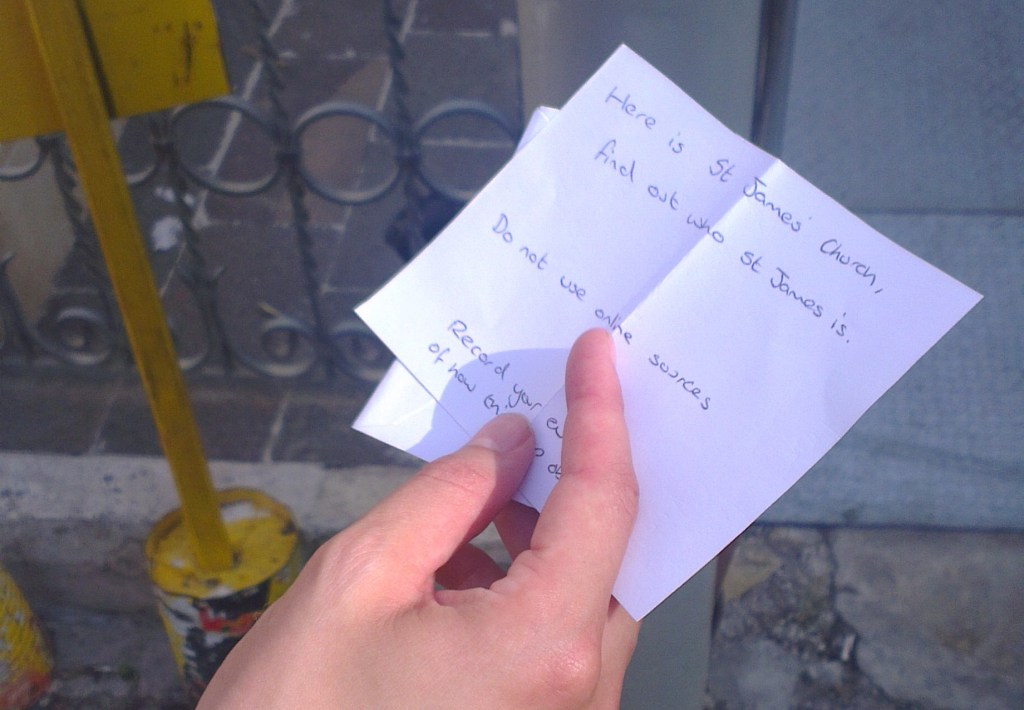
    THE PHOTO that heads this post was taken by me on the second stage of the game. In my hand is a geocache command given to my group from another set of students. As the group had chosen Catholicism as their guiding theme, the other group were tasked with devising a series of geo-located commands in order to structure their thinking on the theme. Gozo is a deeply religious island, as is Malta in general, and the inscription of Catholicism on the physical landscape is hard to ignore. Churches dominate the skyline, from wherever you are, and their red tiled roofs make them easily identifiable. Upon the Rabat Citadel we counted something like 12 red-roofed buildings. On the ground its influence is even greater. Madonna niches are on every corner – and I mean every corner. They are ornate, lighted and well-kept.

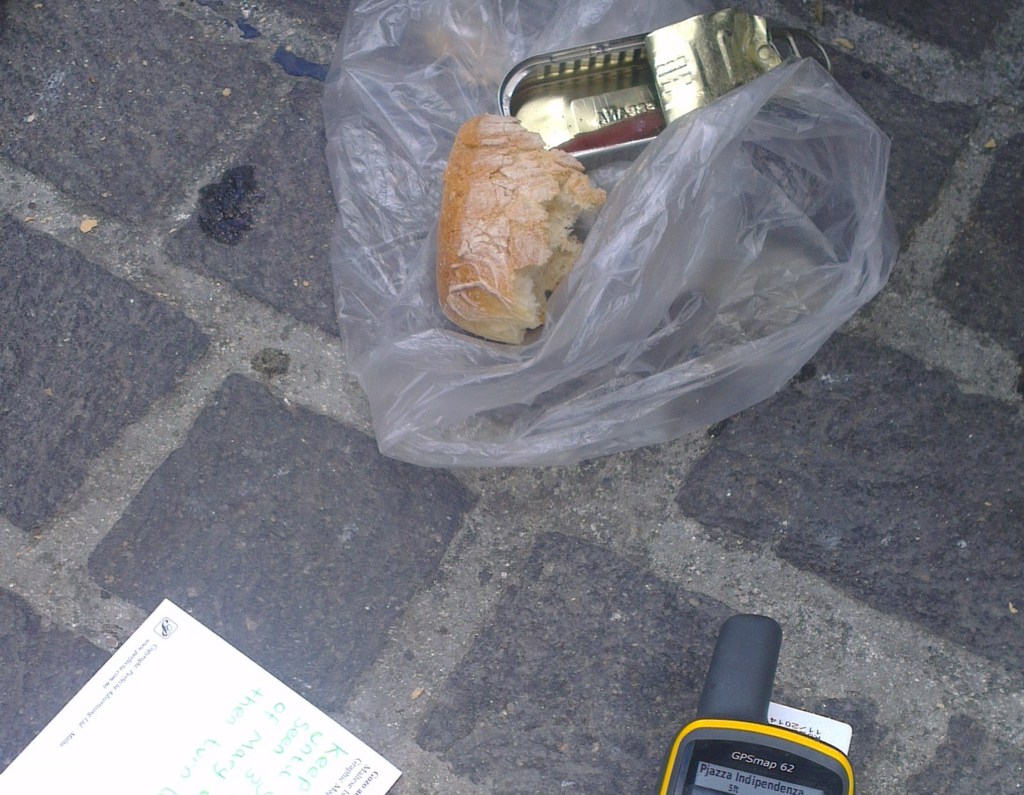
    Religious mosaics, although less common, also provided an interesting talking point for my group. An earlier task on the first stage of the game required them to “eat a food with religious connotation”, and following some discussion (can we drink red wine?) we opted to head to a convenience store for some fresh bread and tinned anchovies (see below). Luckily none of us had an aversion to the latter, although on giving the same task to a later group, eating the anchovies provided a rather haunting experience!

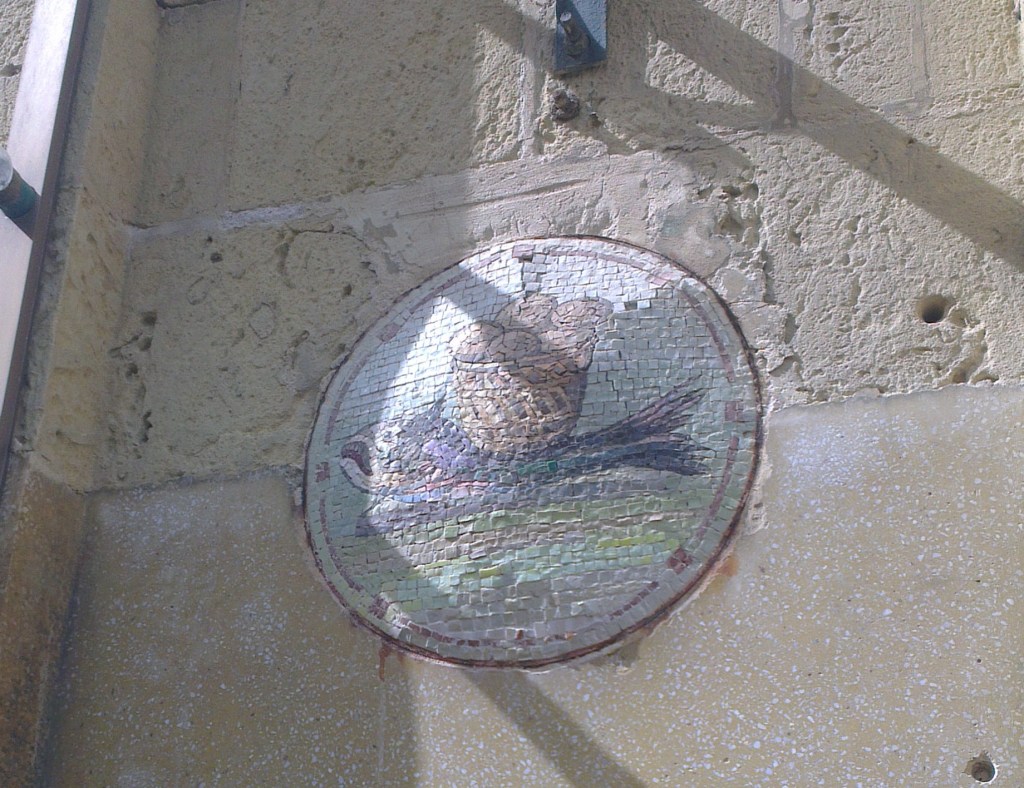
    2013-10-18 12.07.32 - CopyLater, after our delicious meal, we spotted a tiled image on the front wall of a small church. On investigation we discovered its rather delightful symbolism: the fish and basket of bread (below) depicting one of the classically retold miracles. The connection between the initial command (“eat something religious”), the performance of carrying it out (eating outside, on the floor, “humbly”) and the physical architecture (miracle as symbolic object) provided a wonderful opportunity for my group to really interrogate the pervasiveness of Catholicism on this tiny island. And as if to push this connection even further, to really ground the specificity of Catholic practices in Gozo, we discovered another tile – this time in marble on the floor outside the same church – of a desert island scene, complete with palm tree and olive branch-holding bird. It was almost too good to be true.
    2013-10-18 12.16.08 - Copy

    However, therein lay a potential problem. In advancing an understanding of how Catholicism and island life were intimately entwined its importance became overbearing, if not downright wrong. Discussion spread to all manner of activity from family life and daily chores, to sports meetings, local council decisions, schooling and architecture. It became the explanation for everything and resulted in a kind of religious determinism. Although the island is genuinely one of the most avowedly Catholic places I’ve had the pleasure of visiting I, along with other PhD students and staff, was determined to explore a more pluralistic account of everyday life; one that took into account not only other religions alive and well on the island (yes there were some!), but also Catholicism’s own Paganistic beginnings more generally.

    There were two particular moments or sites that allowed us to do so. Firstly, Gozo is home to a Neolithic, megalithic temple complex called Ġgantija. It is a UNESCO World Heritage Site and one of the oldest man-made religious structures in the whole world, dating back over 5500 years. Critically it isn’t a site of Catholic importance. It isn’t a church, shrine or a niche. In fact, it’s thought it was probably a site connected to a fertility cult. Phallic objects and animal carvings recovered from the site are now preserved in the Gozo Museum of Archaeology. So this early religio-spiritual site predates Catholicism on the island. It suggests an alternative, nuanced history of faith and human belief that does not relate directly to the now dominant religion. As part of our attempt to explore this history we hid a bottle at the location of the temples with a quotation from a journal article for my group to find. The quotation came from a paper by Kathryn Rountree in the Journal of the Royal Anthropological Institute on ‘Localizing Neo-Paganism‘. A picture taken by Rountree of a Maltese Pagan praying at a Neolithic temple on the island on page 3 of the article draws the Ġgantija site and the journal text together beautifully.

    2013-10-19 15.58.23

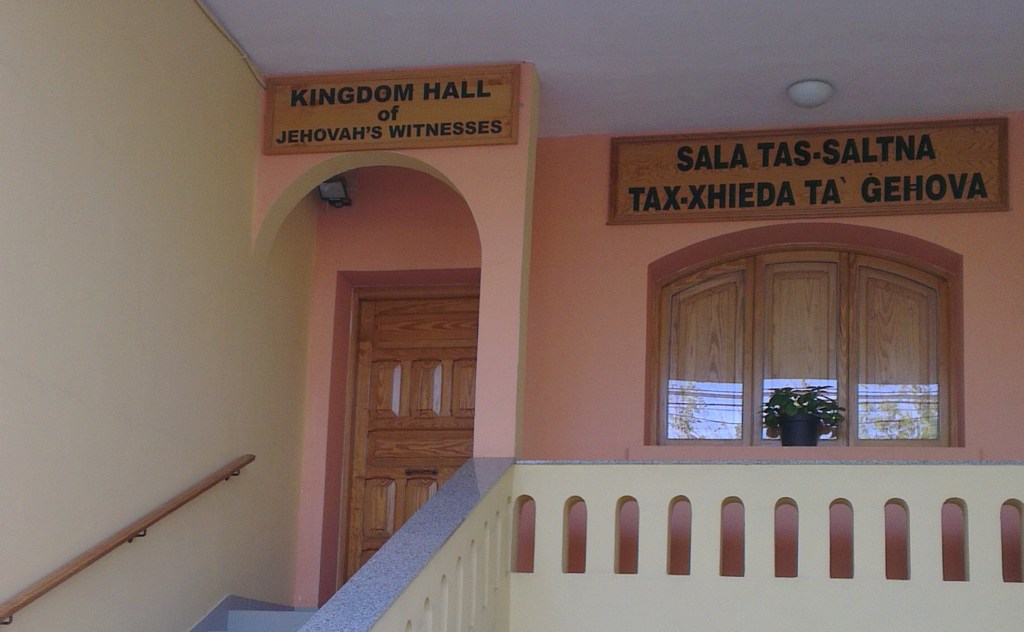
    The second moment provided less fanfare, but in many ways was just as significant. On the return from a particularly exhausting journey “to the edge” (as part of our exploration of another group’s geocache on ‘boundaries’) I spotted, on an otherwise unremarkable street, a Kingdom Hall of Jehovah’s Witnesses. Although far less ostentatious than any Catholic basilica, and far less majestic than any Neolithic ritual site, the Kingdom Hall for local followers was in fact no less important and no less central to the investigation of  religious practice and everyday life on the island. In what could otherwise have been a rather orthodox reading of Catholic life on the island just about managed to tease open a number of alternative narratives that scratched away at not only the embedding of island life within a longer historical framework, but also the contemporary nuance of religious practice. Although Catholicism certainly dictates large swathes of social and cultural life on the island, it is only half the story. The game acted as a practical device to tease open the thematic content of the island. We hope to tweak and re-run it next year with another group of willing participants.