lecturer in digital media and culture at the University of Manchester, UK.

sam.hind@manchester.ac.uk

Category: Politics

  • Living Maps

    Apologies for the silence on this blog of late, because despite coming across a wealth of mapping articles, videos and whatnot, I’ve been rather busy putting together a few pieces of work that have had to take precedence! I will try to remedy this in the next month or so, despite the continuation of these efforts. As a good start, I would like to draw people’s attention towards the 2014 Living Maps Seminar Series which had its launch earlier this month.

    The first was entitled ‘Mapping the Field’ and saw input from Phil Cohen and Christian Nold, following a screening of the short film The Map is Not the Territory. Here are details of the remaining 6 seminars:

     
    SEMINAR 2 : Hidden Histories
    Exploring strategies to excavate hidden layers of cultural and natural histories and put them on the map.
    VENUE: The Building Exploratory, London 11/02/2014
    6:00 pm – 8:00 pm

    SEMINAR 3 : Grounding Knowledge
    Looking at maps that have site specific and partisan purposes, addressing issues of power and politics.
    VENUE: City Centre Queen Mary University of London, London 11/03/2014
    6:00 pm – 8:00 pm

    SEMINAR 4 : Marginalised Bodies, Liminal Spaces
    Looking at issues of disability and the fight for access to the city.
    VENUE: UEL Docklands Campus, London 13/05/2014
    6:00 pm – 8:00 pm

    SEMINAR 5 : Constructing New Geographies
    Addressing the contradictions of mapping the post-modern city: the self-defining spaces and the centres of power.
    VENUE: Dept. of Geography, Environment and Development Studies, Birkbeck University of London, London 10/06/2014
    6:00 pm – 8:00 pm

    SEMINAR 6 : Communities of Resistance
    Case studies in regeneration and gentrification, communities of resistance and the role of ‘counter mapping’.
    VENUE: UCL Urban Laboratory, 4th Floor Central House, London 08/07/2014
    6:00 pm – 8:00 pm

    SEMINAR 7 : Mapping the Future
    How far can GIS be mobilized for radical action; can artists maps offer a representation of emergent political landscapes?
    VENUE: The Young Foundation, London 22/07/2014
  • Why are maps still so powerful?

    Can a map reveal too much? How do they direct our thinking? From ancient atlases to satnav and Google, maps continue to be a key planning tool.

    Rana Mitter hosts a discussion recorded at BBC Radio 3’s Free Thinking Festival at Sage, Gateshead between Vanessa Lawrence CB, head of Ordnance Survey and Professor Jerry Broton. They look at who owns the data? What are they doing with it? Who are they selling it to? Who has peer reviewed the maps?

    Professor Jerry Brotton, Professor of Renaissance Studies in the Department of English, Queen Mary, University of London is the author of A History of the World in Twelve Maps and presenter of the BBC Four TV series Maps: Power, Plunder and Possession.

    Vanessa Lawrence is advisor to the British government on mapping, surveying and geographic information. She is honorary vice-president of the Geographical Association and visiting Professor at the University of Southampton and Kingston University.

    Available here.

  • Mandela’s Spatial Legacy

    A great post by Vanessa Quirk at Arch Daily on the effect of apartheid on South Africa’s towns and cities. She sets the tone with the claim that by:

    Aggressively wielding theories of Modernism and racial superiority, South Africa’s urban planners didn’t just enforce Apartheid, they embedded it into every city – making it a daily, degrading experience for South Africa’s marginalized citizens.

    A link to it is here.

  • Aaron Bastani on protest

    At London Student. From within:

    One increasingly observes a shift to highly choreographed, state-sponsored protest as the only legitimate form of political action on the [UK] street[s]. Simultaneously, the police are becoming ever more determined to make arrests before protests have even occurred, preferring not to deal with finer details such as whether or not the law has been broken. All of this – the data collection, the pre-arrests, the mass arrests, the assaults on activists, the malicious prosecution – is done to actively undermine free assembly and association.

  • Jeu de la Guerre

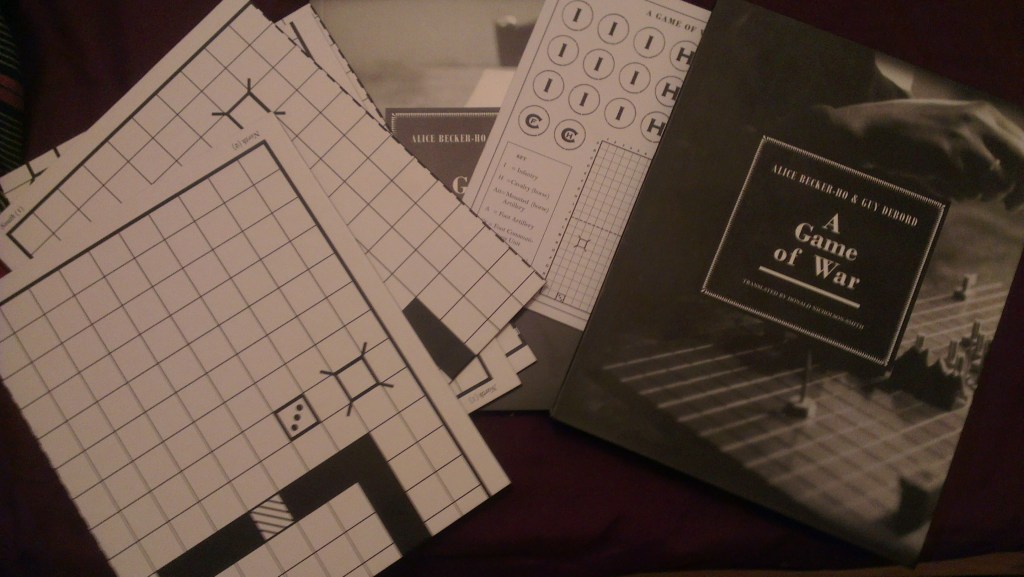
    2013-11-20 16.32.23

    Or, “Game of War” was Guy Debord’s attempt at a strategy war game. In his own words it “embodie[s] the dialectic of all conflict”.

    McKenzie Wark has a fascinating piece from Cabinet Magazine on ‘Debord as Strategist’ from a few years ago. It situates his work in opposition to Constant and his New Babylon project. Alexander Galloway designed an online version 6 years ago but ran into some legal difficulties (see the ‘more information’ tab in the link) with Debord’s estate. Michael Stevenson has some details of a presentation Galloway gave on that project, here.

    I’ve recently purchased the game and accompanying book (see photo above!) and will be playing it with colleagues in the next few weeks. I’ll report back when we do.