lecturer in digital media and culture at the University of Manchester, UK.

sam.hind@manchester.ac.uk

Category: Performance

  • Aaron Bastani on protest

    At London Student. From within:

    One increasingly observes a shift to highly choreographed, state-sponsored protest as the only legitimate form of political action on the [UK] street[s]. Simultaneously, the police are becoming ever more determined to make arrests before protests have even occurred, preferring not to deal with finer details such as whether or not the law has been broken. All of this – the data collection, the pre-arrests, the mass arrests, the assaults on activists, the malicious prosecution – is done to actively undermine free assembly and association.

  • Jeu de la Guerre

    2013-11-20 16.32.23

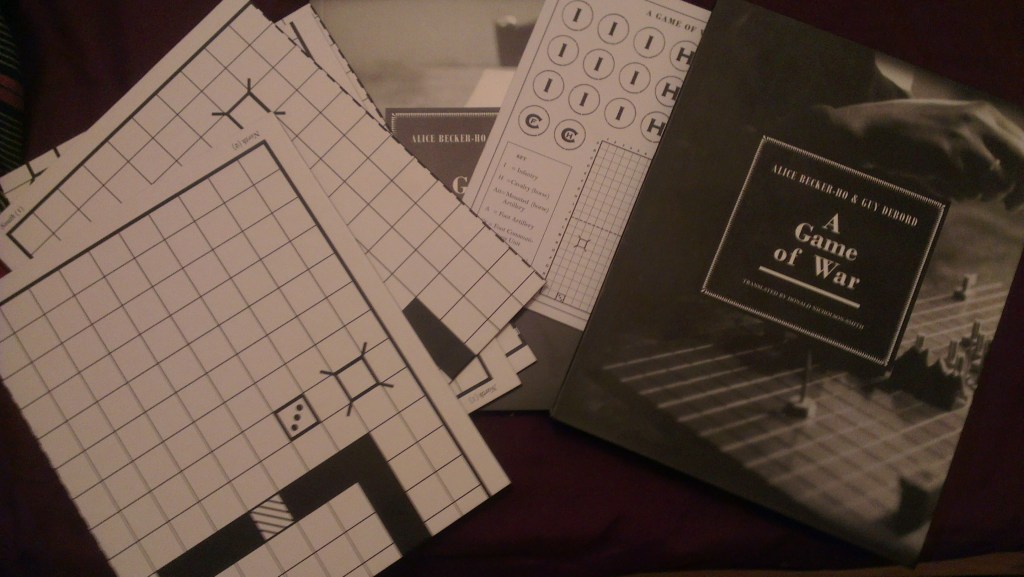
    Or, “Game of War” was Guy Debord’s attempt at a strategy war game. In his own words it “embodie[s] the dialectic of all conflict”.

    McKenzie Wark has a fascinating piece from Cabinet Magazine on ‘Debord as Strategist’ from a few years ago. It situates his work in opposition to Constant and his New Babylon project. Alexander Galloway designed an online version 6 years ago but ran into some legal difficulties (see the ‘more information’ tab in the link) with Debord’s estate. Michael Stevenson has some details of a presentation Galloway gave on that project, here.

    I’ve recently purchased the game and accompanying book (see photo above!) and will be playing it with colleagues in the next few weeks. I’ll report back when we do.

  • The Matter of ‘Virtual’ Geographies

    Sam Kinsley’s ahead-of-print article entitled “The matter of ‘virtual’ geographies” (subs. required) is online at Progress in Human Geography now. Like all Progress articles are meant to be, Sam’s is a ‘state of play’-type piece built around the problematic notion of ‘the virtual’. Although he is right to note that most geographers have ceased to write explicitly about ‘cyberspace’, ‘cyber-geographies’ and the like, the spectre of the virtual still haunts much digital work in the discipline.

    He proceeds in three sections, detailing the three main ‘camps’ that geographers have operated in to understand the digital, notably through:

    • The automatic production of space (Thift, Graham, Marvin etc.)
    • Spaces of calculation (Adey, Amoore, Barnes, Cowen etc.)
    • Transductions (Kitchin, Dodge, Wilson, Ash etc.)

    His constructive criticism of work under the first banner is that there are (relatively) few empirical studies of how automatic productions of space do work in the world. Under the second, there have been far fewer studies of non-state actors involved in the calculative dynamics of spatial control, with an overwhelming emphasis on state actors. For the third, Kinsley simply suggests – pace Kitchin and Dodge – that continued work in geography needs to focus on the ‘increasing transductive agency of the digital in everyday life’ in order to negotiate the ‘ongoing reformulation of what it is to be human’ (p.7).

    In the final chapter Kinsley suggests a future research focus that can help develop deeper thinking on the materiality of the digital. He does this through an appeal to the notion of ‘technicity’ (a term popularized by Stiegler), as well as building upon the previously introduced term ‘transduction’ (brought into geography by Kitchin and Dodge via Adrian Mackenzie). Towards the end of this section, in order to provide readers with a helping empirical hand, Kinsley then considers the ‘transduction that takes place in the sending of a text message’ (p. 12) to ground the more theoretical discussion thus far:

    [R]ather than being an ‘immaterial’ process, there is a significant network of matter and energy upon which this ‘virtual’ activity is predicated. A device, usually a phone, is used to input the message. The physical functions of that device are contingent upon a wealth of highly processed materials, often with complicated origins, enmeshed into complex chemical arrangements and interdependent components. For example, a capacitative touch screen, made from glass and electrically conductive materials, uses the body’s electrical capacitance to sense the point of touch (Greenstein, 1997: 1318). This is often processed via one of many Application-Specific Integrated Circuit chip in the device, feeding data to other components that process software, which in turn changes the electrical charge within different areas of the screen (pixels) to display images. To ‘send’, the software engages the modem of the device to communicate with the network, translating data into modulated pulses in particular frequencies of the electromagnetic spectrum. (p. 12)

    Further, that the phone network infrastructure; of transceiver towers, copper cables, exchange points, device protocols and server centres all take a central part in the sending of a simple text message. Although we might not be able to comprehend that this vast, disparate infrastructure is required for the transmission of such an everyday thing, as geographers we must be attentive to the ongoing rematerializations that take hold of our apparently ‘virtual’ worlds.

    Whilst Kinsley is essentially making a very modest suggestion – “we need to pay attention to the inseparability of technology and humanity” – it is a suggestion that many have yet to take seriously at a predominantly empirical level within the field of human geography.

  • Planning for Protest

    The Occupied Times has a fantastic missive from a project calling themselves Planning for Protest on their website at the minute. Organized for the Lisbon Architecture Triennial, the project is designed to “explore both the social and architectural definitions of protest in light of the current global financial crisis”:

    Planning for Protest came about as a conversation over what was happening in these flashpoints throughout the world, with a special focus on how the very spaces in which they took place helped to shape or form, if not circumvent, the success or failure of each cities’ public mobilisation. Inasmuch as the mass convention of peoples creates the voice of these protests, we wanted to see how the streets and squares, its buildings, form the backdrop of these protests’ stages.

    12 architects/architect offices were brought together to compile a unique set of ‘typologies’ of each urban protest movements taking part around the world. Athens, Berlin, Bucharest, Cairo, Dublin, Istanbul, Lisbon, London, Madrid, New York, Rome and Sao Paulo are all represented.

    Although they say in the Occupied Times article that they wanted people to “see how the streets and squares, its buildings, form the backdrop of these protests’ stages”, I think it actually does far more than that. In fact, the project actually works to show how the streets, squares and buildings of each protest movement aren’t in the background at all, and aren’t mere ‘stages’ for the apparently more theatrical human actions laid on top. In all cases they are active, foregrounded actors in the nature of protest. The built environment is a primary facilitator of protest. If you delve into the case studies you’ll actually find that most work with this notion anyway, describing, as an example, how the design of city squares can affect the shape, volume, mobility and intensity of protests (see the photo above from Studio Basar – Bucharest).

    Another example can be seen in the image below. It is taken from Cluster’s Cairo effort and contains some compelling graphics elucidating the impact of vernacular structures on the urban fabric. As a form of ‘slow’ protest, Cluster argue that street vendors are helping to contest the nature of public space. In marking out their territory they are helping to define and delineate the margins of acceptable, agreeable behaviour. Although at the bottom-rung of the urban hierarchy (below NGOs, residents, real estate developers etc.) their efforts to stake a claim to the city environment do not go unrecognized – at least to Cluster. This ‘encroachment of spatial informality’ in the form of creeping vernacular architectures, whilst identified by the group as an alternative force to the ‘urban protest as spectacle’, nonetheless provides a compelling example of contemporary urban protest. 

  • “Capturing”

    Matthew Wilson and Sarah Elwood’s chapter on “capturing” for the SAGE Handbook of Human Geography is now available as a preprint version here. It contains a superb quote by Bill Bunge on the problem of certain kinds of academic enterprise:

    We are in the computer center watching the printout to see if it is raining  outside. If the ghetto burns down we will not know it because it does not  show on the symap. If it is not in the census, it is not sensed. If remote  sensing is efficient, and it is, why does it follow, and it does not, that intimate sensing is not? We have become so situational that we have lost sight of the site unless we can cite it in a senseless census. (1974, 488)

    There are sections on ‘junctures’, ‘representation and data’, ‘analysis and interpretation’ and ‘production and participation’.