lecturer in digital media and culture at the University of Manchester, UK.

sam.hind@manchester.ac.uk

Category: Performance

  • Mobile Media: Making-Cooperation-Work

    The Charting the Digital team will be making an appearance at the upcoming ‘Mobile Media: Making-Cooperation-Work’ conference in Siegen from the 19th-21st June 2014. As the conference organizers posit:

    The growing mobility of people, data and infrastructures is presenting media with new challenges. Where virtuality was till the centre of attention in immobile use, smart-phones, in particular, are currently showing us how central social connectivity, contextual sensing, micro-coordination, and haptic feedback are to our understanding of media practices. At the same time, a variety of phenomena that could be understood as mobile media, such as map apps or connected vehicles, reveal that more and more infrastructures, goods and tools have to be digital and networked in order to make a mediation process possible, as actually portrayed with the Internet of Things. Thus, what this conference aims to focus on, is the specifities of certain media as forms for cooperation.

    Led by Nanna Verhoeff, we intend to present on a recent collaborative experiment soon to be carried out in Oxford, UK. Tentatively titled Footage, the experiment is an attempt to bring together playful, navigational and temporal themes in a practical, urban setting.

    More details are available at the conference website here. A brief outline is below:

    In Footage we [will] use…playful and mobile methods to experiment with notions of temporality, mapping media and space. As a collaborative “experiment” it builds on the ideas of Michel de Certeau: of walkers’ traces and tactics and of spatial and navigational forms, conducted in teams in the city of Oxford as “laboratory” (May 2014). It aim[s] to engage with performative and playful navigational practice-based mobile methodologies and the development of analytical tools for analyzing these mobile and collaborative practices. In this (collaborative) presentation, we will present the goals and design of the experiment, and our experience as researchers working as a team and working with groups of participants.

    This mobile game/experiment [i]s specifically designed to reflect on the way in which the city of Oxford holds time and how it comprises a multitude of differing temporalities. The interpretation of these temporalities is experiential – navigational and chronological versus networked and relational. In the experiment we [will] work… with different media maps (still images, moving-image footage, sound, etc.) that encourage…participants to think differently about the way in which you read these maps, experience navigating with them, and then respond to the different temporalities these inform.

  • ‘Outsmarting Traffic Together’: Driving as Social Navigation

    Alex Gekker and I have a new open-access article out in Exchanges: the Warwick Research Journal. Volume 1 (2) also includes a conversation with Hannah Jones who is currently leading a joint project on the Home Office’s ‘Go Home’ immigration campaign.

    The abstract:

    The automotive world is evolving. Ten years ago Nigel Thrift (2004: 41) made the claim that the experience of driving was slipping into our ‘technological unconscious’. Only recently the New York Times suggested that with the rise of automated driving, standalone navigation tools as we know them would cease to exist, instead being ‘fully absorbed into the machine’ (Fisher, 2013). But in order to bridge the gap between past and future driving worlds, another technological evolution is emerging. This short, critical piece charts the rise of what has been called ‘social navigation’ in the industry; the development of digital mapping platforms designed to foster automotive sociality. It makes two provisional points. Firstly, that ‘ludic’ conceptualisations can shed light on the ongoing reconfiguration of drivers, vehicles, roads and technological aids such as touch-screen satellite navigation platforms. And secondly, that as a result of this, there is a coming-into-being of a new kind of driving politics; a ‘casual politicking’ centred on an engagement with digital interfaces. We explicate both by turning our attention towards Waze; a social navigation application that encourages users to interact with various driving dynamics.

    It’s available to download here, and I’ve also put a download link on the about page of this blog.

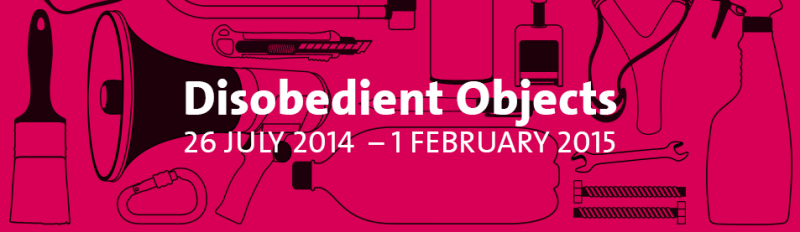
  • Disobedient Objects at the V&A

    Disobedient Objects

    An absolutely fabulous looking exhibition is set to take place at the V&A from 26th July on ‘the powerful role of objects in movements for social change’.

    Curated by Catherine Flood and Gavin Grindon, it is a look at the material world of protest events, long ignored by those theorizing the nature of social movements. Although there is a rich history of banner-making in the trade union movement, little has been done to link up this obviously creative, material work and more recent innovative object-making. The exhibition therefore includes:

    …finely woven banners; defaced currency; changing designs for barricades and blockades; political video games; an inflatable general assembly to facilitate consensus decision-making; experimental activist-bicycles; and textiles bearing witness to political murders.

    These comprise the ‘augmented reality’ of protest events. That is to say, they are necessary appendages. Without an array of material items social movements lack the ability to amplify phenomena, transform worlds and build alternative knowledges. They allow protesters and activists to test the limits of opposing forces in a spatial form. Above all, they are tactics for expressing beliefs. No social movement can exist without a fine inventory of playful, visual, sonic, material and ‘disobedient’ objects.

    The exhibition will run until 1st February 2015. You can follow updates on the exhibition blog here.

  • Living Maps III: Grounding Knowledge

    Indigmaps
    Five Dreamings, painter – Michael Nelson Jakamarra, assisted by Marjorie Napaljarri, Papunya, Central Australia, 1984 acrylic on canvas, 122 x 182 cm.

    Next Tuesday will see the third seminar in the Living Maps series. After ‘Mapping the Field’ and ‘Hidden Histories’, ‘Grounding Knowledge’ will see Øyvind EideIain Boal and David Pinder tackle issues of power and politics. I will be travelling down to London from Manchester for it myself.

    Hosted this time at QMUL, the seminar will aim to interrogate the epistemological bases for mapping in the modern world. Questions such as “how are maps situated?”, “how do they tell specific stories?” and “how do they propose new ways of existence?” all pertinent.

    Content from seminar’s ONE and TWO can also be viewed over at the Living Maps website. Tickets for each seminar are priced at £5 for students/unwaged and £20 for professionals/academics. They can be purchased individually from here. It will run from 18.00 – 20.30.