lecturer in digital media and culture at the University of Manchester, UK.

sam.hind@manchester.ac.uk

  • Call for PhD Summer School of Cultural Transformations‏

    2nd Ph.D. Summer School of Cultural Transformations:

    Please circulate to PhD students

    Cultural Im/materialities: Contagion, Affective Rhythms and Mobilization

    International PhD course, 23-27 June 2014, Aarhus University, Denmark

    The summer school is funded by the Ph.D. programmes Art, Literature and Cultural Studies and ICT, Media, Communication and Journalism and by Centre for Sociological Studies Aarhus University (all Aarhus University). The event is part of a cultural studies summer school network with Warwick University, University of Southern Denmark, Södertörn University and Aarhus University as partners. The first event in 2013 was hosted by Warwick University.              

    Organisers      

    Associate Professor, PhD, Britta Timm Knudsen; Associate Professor, PhD, Mads Krogh; Assistant Professor, PhD, Carsten Stage; Associate Professor, PhD, Anne Marit Waade

    Partners: Warwick University, UK, University of Southern Denmark, DK, Södertörn University, SE, CESAU, DK, Copenhagen Business School, DK

    Confirmed keynotes

    Professor Georgina Born (Music and Anthropology, Oxford University), UK
    Reader Tony D. Sampson (Digital Culture and Communications, University of East London), UK
    Professor John Protevi (Philosophy and French Studies, Loyola University Chicago), US
    Senior Lecturer Luciana Parisi (Cultural Studies, Goldsmiths), UK

    Lecturers / workshop organizers / discussants

    Jenny Sundén, Södertörn University
    Nathaniel Tkacz, Warwick University
    Christian Borch, Copenhagen Business School
    Representative from University of Southern Denmark
    Anne Marit Waade, Aarhus University
    Carsten Stage, Aarhus University
    Mads Krogh, Aarhus University
    Britta Timm Knudsen, Aarhus University
    Christoffer Kølvraa, Aarhus University
    Louise Fabian, Aarhus University
    Camilla Møhring Reestorff, Aarhus University

    ECTS: 5 ECTS

    Time: June 23-27 2014

    Room and Place: Aarhus University
    Cost/ Policy: No cost fee, each participant covers travel & accommodation.
    Max. number of participants: 30

    Description

    The summer school wants to explore the role of affect, suggestive rhythms and contagion for the somatic mobilization of agents across a range of socio-cultural situations (e.g. protest events, dance halls, online forums, catastrophes), practises and processes (e.g. political mobilization and engagement, school bullying, youth loneliness, xenophobic/nationalist panics). In recent years an increasing interest in materiality, space, technology and embodiment has developed in the humanities and social sciences combined with an ëaffective turní (Clough, Massumi, Thrift, Seigworth and Gregg, Ahmed) to immaterial dimensions of these phenomena.
    This has re-actualised early sociological theories about affective suggestion, contagion and imitation (e.g. Gustave Le Bon and Gabriel Tarde), which offer valuable insights to the analysis of a contemporary cultural landscape characterised by for instance viral/memetic phenomena, mediated/networked/rhythmically coordinated crowds, affective online communication and political modulation of citizen affects (Blackman, Borch, Gibbs, Sampson, Butler). During the summer school we wish to collectively explore the immaterial dimensions of the material social world and vice versa, discuss the potentialities, implications and risks of such analysis in an open interdisciplinary environment.
    The event will attract PhD students from a range of academic fields (anthropology, geography, media, cultural studies, aesthetics, sociology, political science etc.) interested in, and doing research on, the affective turn, processes of imitation/suggestion/contagion, the rhythmically attuning mobilisation of bodies, and the im/material dimensions of culture and the social world.
    Possible areas/topics:
    • The affective dimensions of materiality, space, technology and things
    • Aesthetics and affectivity, sensual design
    • Mobilization within public and private spheres of action
    • Viral communication, virality in the media, memes, social media
    • The methodological challenges of analysing cultural materialities and immaterial processes
    • Theoretical legacies to the ëaffective turní and new materialist orientations within the humanities and social sciences; early sociologies of contagion, suggestion and imitation
    • Moral, media and financial panics
    • Music culture, sound, dance and rhythm
    • Industries of affect, affective consumption
    • Tourism, black spot/dark tourism
    • Artistic agency, idols and fandom
    • Crowds, protest culture, social movements, (creative/eventful) activism, political events
    • Depression, loneliness, bullying, affective exclusion
    • Charity, empathy and sympathy
    • Affect, emotion and power, war and affective modulation
    • Xenophobia, nationalism, the strategic production of fear and hate
    • Atmosphere, aura, prestige
    • Sexuality, porn, love and care
    • The affectivity of catastrophes
    • Blasphemy, fanaticism and provocative politics
    The Ph.D.-summer school will be based on keynote presentations, workshops and studentsí own project presentations and organized feedback sessions.

    Exam

    The examination will consist of three parts: 1. Full paper hand-in (deadline May 15); 2. Attending workshops and doing group assignments; 3. Paper presentation and discussion of papers.

    Deadline for submission

    Deadline: March 1 2014
    Send an email to: Marianne Hoffmeister mho@adm.au.dk
    Attach a description of your research topic and project (max. 300 words).
    March 15: You will get to know if you participate, and you will be asked to confirm your  participation.

    Preparation for PhD students

    April 1: The organizers will form groups out of the participants (5 in all) and each group has to organize a slot of one hour each with a social and/or academic content (e.g. academic speed-dating, guided tours in Aarhus for strangers by strangers, exercises between the slots).

    May 15: Deadline for submitting a full paper (10 pages).

    Preparation for teachers

    March: Organizers must read the abstracts and form participants groups.

    Medio May: The group of teachers will be responsible for 3-4 papers, that he/she has read  carefully in advance in order to 1) place the paper within the theme of the summer school 2) to be a discussant of the paper and to give an open and constructive feedback at the summer school.

    About the summer school network (SSCT)

    The series aims at creating an international environment of constructive academic discussions in the field of cultural studies in order to strengthen this discipline in our respective academic communities and to develop the discipline of cultural studies according to actual developments and new theoretical paradigms. The series aims at improving teaching in cultural studies through a meticulous work on theoretical, methodological and empirical challenges. It is also our intention to build stronger research relations and exchange opportunities between the involved institutions and participants. Network coordinator: Carsten Stage (norcs@hum.au.dk).
  • Friday Map Art

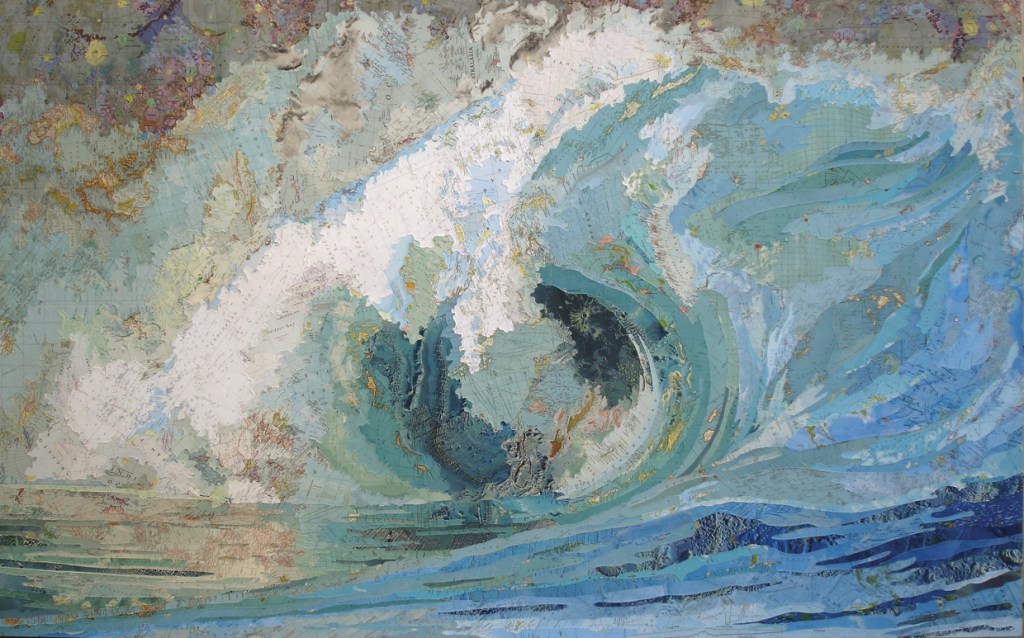
    Fionas-Wave-2006-Maps-on-wood-panel-by-Matthew-Cusick

    Matthew Cusick is a New York-based artist. He has a beautiful array of map works on his website and some other collages that further utilize topographical maps to create rich, swirling tapestries. The photo above is of a piece entitled Fiona’s Wave (2005).

  • Playing Gozo

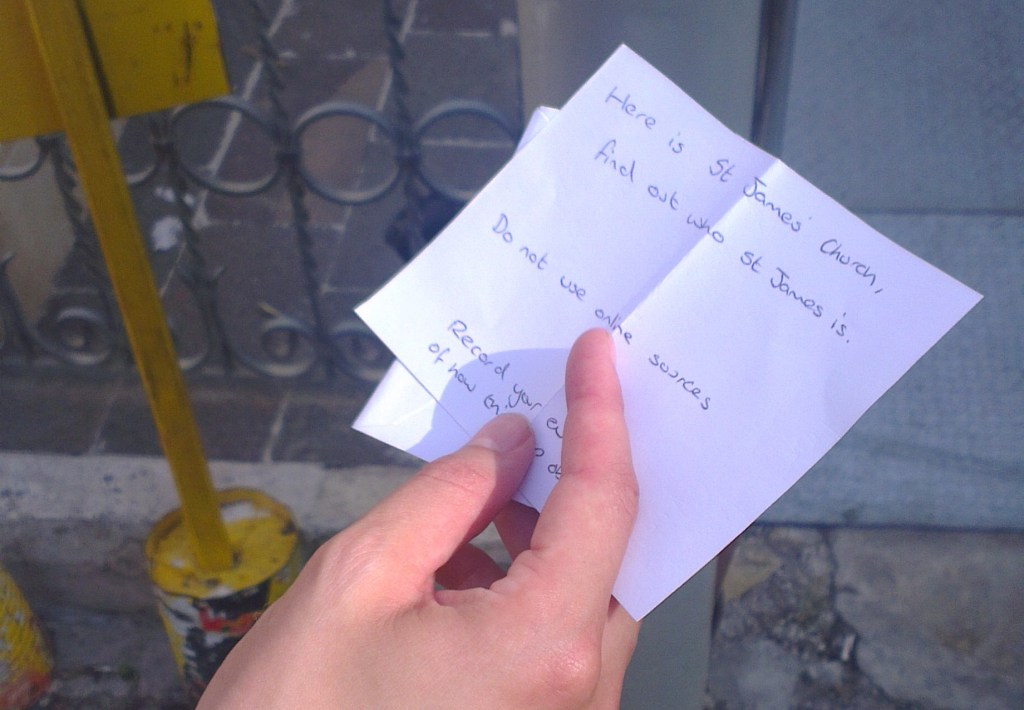
    2013-10-19 14.48.18 - Copy

    Fellow Charting the Digital member Alex Gekker has put together a thoughtful piece over at his blog on the experience of devising and participating in a game for a group of undergraduate geographers. If you desire to know about the mechanisms of the game, please read Alex’s post. I also helped put together and play the game myself, and I offer up some of my own thoughts below:

    THE PHOTO that heads this post was taken by me on the second stage of the game. In my hand is a geocache command given to my group from another set of students. As the group had chosen Catholicism as their guiding theme, the other group were tasked with devising a series of geo-located commands in order to structure their thinking on the theme. Gozo is a deeply religious island, as is Malta in general, and the inscription of Catholicism on the physical landscape is hard to ignore. Churches dominate the skyline, from wherever you are, and their red tiled roofs make them easily identifiable. Upon the Rabat Citadel we counted something like 12 red-roofed buildings. On the ground its influence is even greater. Madonna niches are on every corner – and I mean every corner. They are ornate, lighted and well-kept.

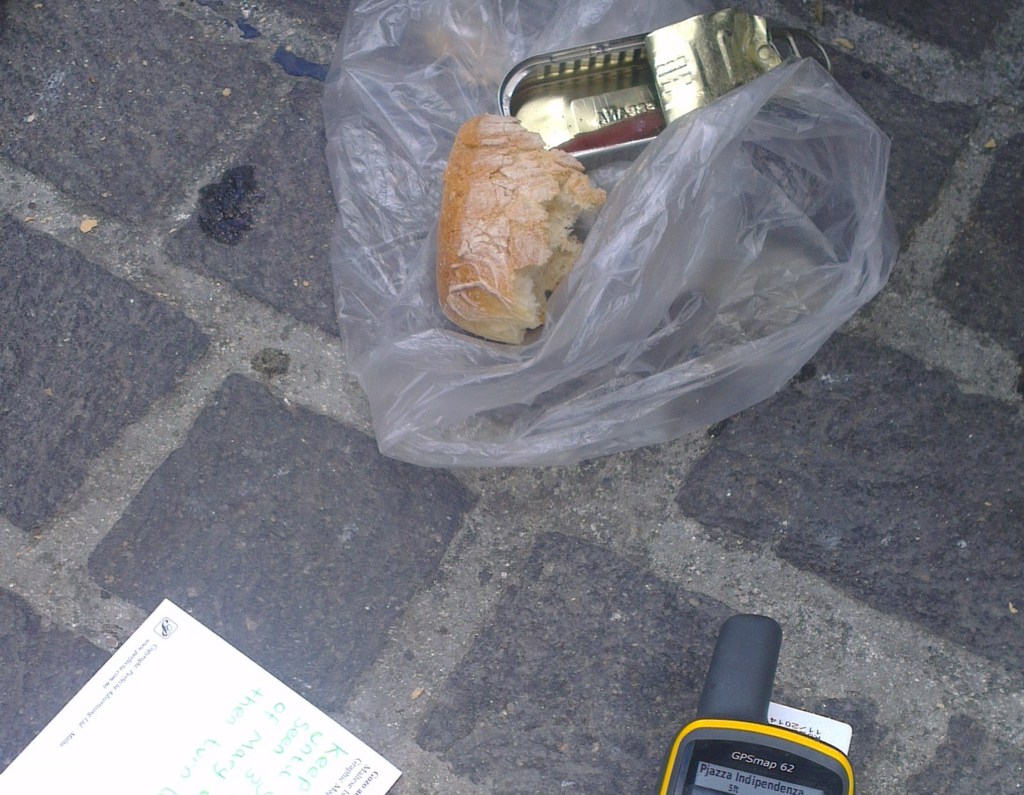
    Religious mosaics, although less common, also provided an interesting talking point for my group. An earlier task on the first stage of the game required them to “eat a food with religious connotation”, and following some discussion (can we drink red wine?) we opted to head to a convenience store for some fresh bread and tinned anchovies (see below). Luckily none of us had an aversion to the latter, although on giving the same task to a later group, eating the anchovies provided a rather haunting experience!

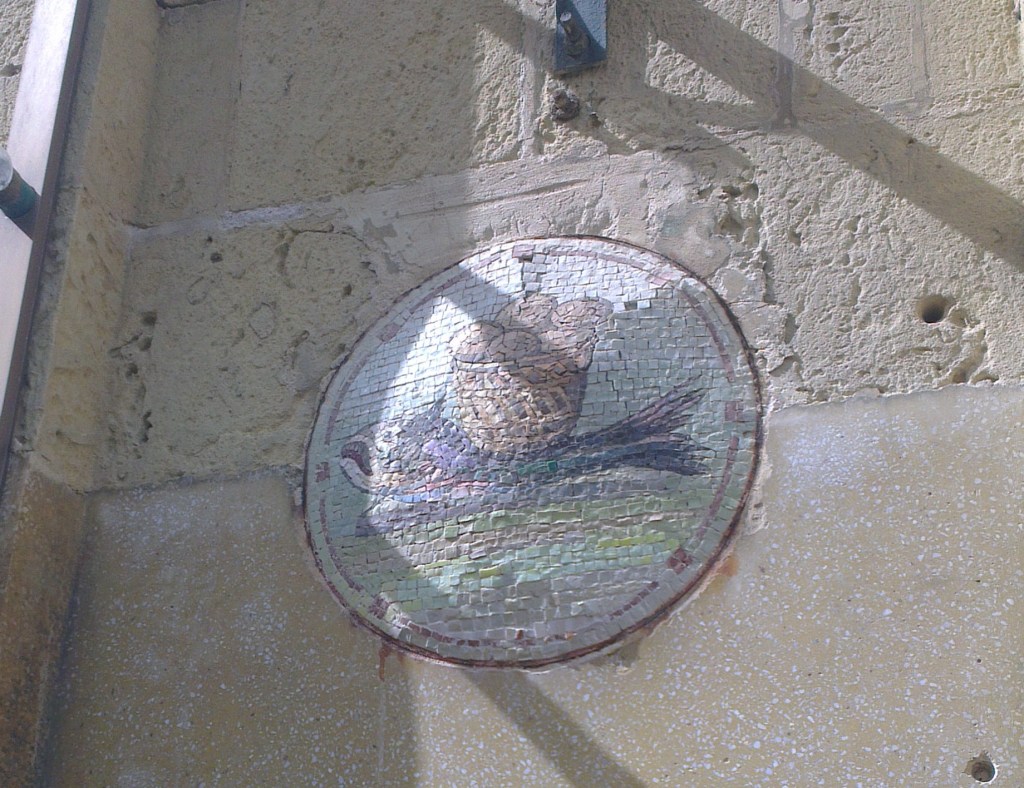
    2013-10-18 12.07.32 - CopyLater, after our delicious meal, we spotted a tiled image on the front wall of a small church. On investigation we discovered its rather delightful symbolism: the fish and basket of bread (below) depicting one of the classically retold miracles. The connection between the initial command (“eat something religious”), the performance of carrying it out (eating outside, on the floor, “humbly”) and the physical architecture (miracle as symbolic object) provided a wonderful opportunity for my group to really interrogate the pervasiveness of Catholicism on this tiny island. And as if to push this connection even further, to really ground the specificity of Catholic practices in Gozo, we discovered another tile – this time in marble on the floor outside the same church – of a desert island scene, complete with palm tree and olive branch-holding bird. It was almost too good to be true.
    2013-10-18 12.16.08 - Copy

    However, therein lay a potential problem. In advancing an understanding of how Catholicism and island life were intimately entwined its importance became overbearing, if not downright wrong. Discussion spread to all manner of activity from family life and daily chores, to sports meetings, local council decisions, schooling and architecture. It became the explanation for everything and resulted in a kind of religious determinism. Although the island is genuinely one of the most avowedly Catholic places I’ve had the pleasure of visiting I, along with other PhD students and staff, was determined to explore a more pluralistic account of everyday life; one that took into account not only other religions alive and well on the island (yes there were some!), but also Catholicism’s own Paganistic beginnings more generally.

    There were two particular moments or sites that allowed us to do so. Firstly, Gozo is home to a Neolithic, megalithic temple complex called Ġgantija. It is a UNESCO World Heritage Site and one of the oldest man-made religious structures in the whole world, dating back over 5500 years. Critically it isn’t a site of Catholic importance. It isn’t a church, shrine or a niche. In fact, it’s thought it was probably a site connected to a fertility cult. Phallic objects and animal carvings recovered from the site are now preserved in the Gozo Museum of Archaeology. So this early religio-spiritual site predates Catholicism on the island. It suggests an alternative, nuanced history of faith and human belief that does not relate directly to the now dominant religion. As part of our attempt to explore this history we hid a bottle at the location of the temples with a quotation from a journal article for my group to find. The quotation came from a paper by Kathryn Rountree in the Journal of the Royal Anthropological Institute on ‘Localizing Neo-Paganism‘. A picture taken by Rountree of a Maltese Pagan praying at a Neolithic temple on the island on page 3 of the article draws the Ġgantija site and the journal text together beautifully.

    2013-10-19 15.58.23

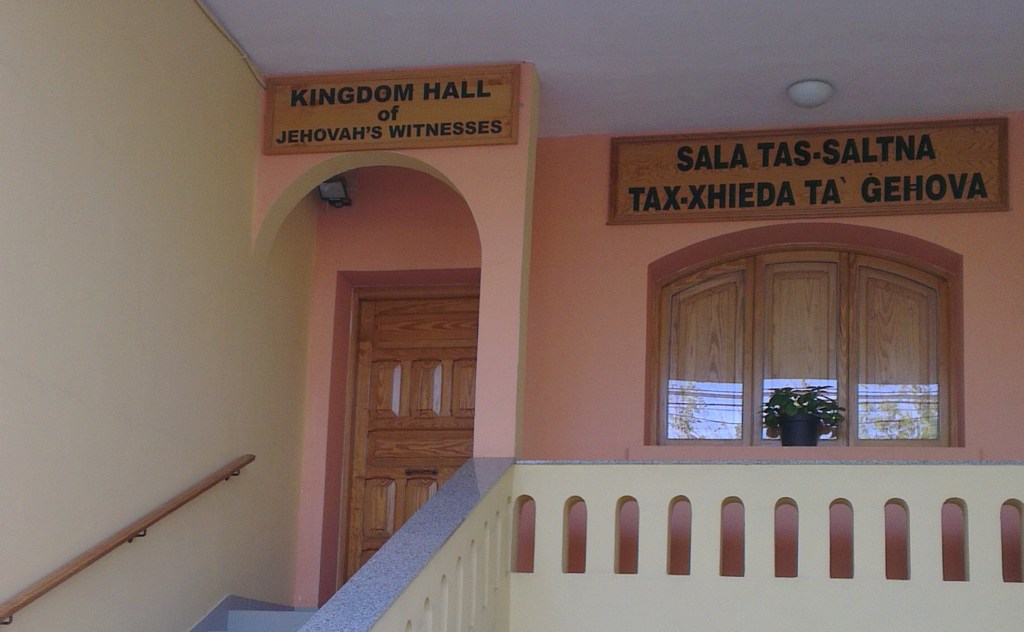
    The second moment provided less fanfare, but in many ways was just as significant. On the return from a particularly exhausting journey “to the edge” (as part of our exploration of another group’s geocache on ‘boundaries’) I spotted, on an otherwise unremarkable street, a Kingdom Hall of Jehovah’s Witnesses. Although far less ostentatious than any Catholic basilica, and far less majestic than any Neolithic ritual site, the Kingdom Hall for local followers was in fact no less important and no less central to the investigation of  religious practice and everyday life on the island. In what could otherwise have been a rather orthodox reading of Catholic life on the island just about managed to tease open a number of alternative narratives that scratched away at not only the embedding of island life within a longer historical framework, but also the contemporary nuance of religious practice. Although Catholicism certainly dictates large swathes of social and cultural life on the island, it is only half the story. The game acted as a practical device to tease open the thematic content of the island. We hope to tweak and re-run it next year with another group of willing participants.

  • Serres on Tintin

    French philosopher Michel Serres on Tintin. If anyone could translate some of the key details please do get in touch UPDATE Terence Blake has kindly translated the video here – although from Serres’ body language and gesticulations I do get the feeling he’s a rather big “Tintinophile”.

    My undergraduate dissertation was a postcolonial reading of four Tintin titles – Tintin in the Congo, Land of Black Gold, King Ottokar’s Sceptre and Tintin and the Picaros – and I remain deeply interested in the cultural legacy of Hergé’s most famous series. My argument, which I continue to support now, was that Hergé’s treasured creation was deeply and inherently Colonialist, with all the racial, imperial and paternalistic connotations that came with it. Part of my attempt was to move beyond the official narrative that I believe has plagued common readings of the series so far; that the early overtly racist (Congo) and propagandist (Land of the Soviets) titles were simply the results of youthful folly under the tutorship of a Catholic abbot. I claimed that, throughout, Hergé had utilized his ligne claire style of drawing to create an allure of social truth, realism and objectivity, whilst ‘othering’ a whole host of characters from West Africa (in Congo), the Middle East (Arabs in Black Gold, Jews in The Shooting Star), South America (in Picaros) and Japan (in Blue Lotus).

    I was just discovering Said’s magisterial Orientalism (1978) and getting to grips with Derek Gregory’s incredible Geographical Imaginations (1994) and his later work on The Colonial Present (2004) so to say I was influenced by subaltern and postcolonial studies is putting it lightly. Other titles by James Ryan, Jason Dittmer, Thierry Groensteen, Catherine Lutz & Jane Collins were all massive influences on my reading of imperialism, geopolitics, bande dessinée and photography. I’ve uploaded the thesis to my about page if anyone is interested. All the aforementioned titles are referenced within.   

    Famously, Charles de Gaulle said Tintin was his only international threat, and Serres himself also declared Hergé to have had the “most impact on contemporary French life” of any author, ever. The irony of both these comments, of course, was that neither Hergé or Tintin were actually French themselves – both being proudly, yet perhaps indistinctly, Belgian.

    A new temporary exhibition on Tintin in India has launched this week at the Musée Hergé for those in the Brussels area too, and runs until January 2014. 

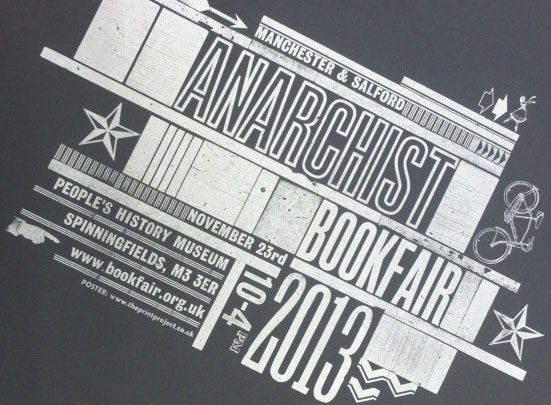
  • Manchester & Salford Anarchist Bookfair 2013

    1383229_319447664859728_1019128745_n

    At the People’s History Museum, Saturday 23rd November, 10am – 4pm. For more information, see here. Here’s a short selection of stalls that will be there on the day (click here for the complete list):

    Hand Job Zine
    http://handjobzine.wordpress.com

    We are a DIY literary zine that collects writing and illustration from around the UK, trying to give a voice to many people with opinions and beliefs that are shunned or undervalued by a lot of the mainstream literary journals and magazines. We present it as an anarchist zine, but as long as people have an interesting idea we will put it in there.

    Manchester Social Centre
    http://manchestersocialcentre.org.uk/
    https://www.facebook.com/ManchesterSocialCentre

    There has been a growing need for a radical community hub in the years since Manchester’s last social centre, The Basement, was closed due to flooding. Manchester Social Centre aims to fill this void by reclaiming space and services within the city and turning it into a ‘corporate free’ sanctuary for the community. We want to create a space for local activity and interaction, enabling groups to hold meetings and events at low cost, for members to share resources, develop and form links with other groups, and providing an accessible means for the people of Manchester to unite and share in positive radicalism.

    News From Nowhere
    http://www.newsfromnowhere.org.uk
    https://www.facebook.com/newsfromnowherebookshop
    39-year old Radical and Community Bookshop based in Liverpool. All subjects covered in a subversive way. A workers’ co-operative run by a women’s collective – shop with the real Amazons!

    STRIKE! Magazine
    http://www.strikemag.org
    STRIKE! is a radical, quarterly newspaper – we deal in politics, philosophy, art, subversion and sedition. Each issue we gather together a group of high-grade artists and authors, give them a theme, and let them get creative with it. It’s a magazine, it’s a journal, it’s a carnival.