
Following on from some recent posts on walking, I thought I’d link to another interesting article. This time from Eduardo Ares at Polis.
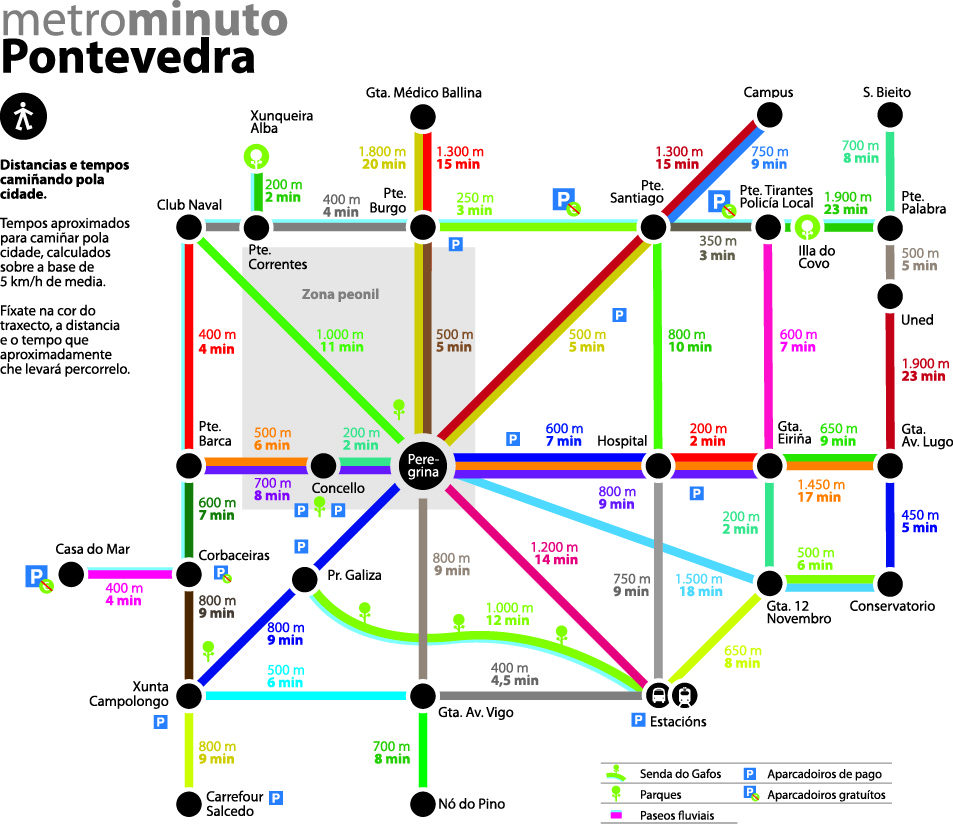
The metrominuto map above shows the distance and time it takes to walk across the city of Pontevedra in northwest Spain. Rendered in the style of the ubiquitous London Tube Map, metrominuto is the local council’s way of turning their small city into a navigable, hospitable and walkable terrain. Together with the map, Pontevedra have taken a number of other steps to make the city pedestrian-friendly. As Ares says:
Instead of razing old buildings and constructing bigger roads, the city council began taking proactive measures to reduce traffic. They widened sidewalks, established a free bike-lending service, installed speed bumps and set a speed limit of 30 kilometers per hour throughout the city. They even banned motorized transport in sections of Pontevedra. Walking zones now extend from the historic center to streets and squares in newer neighborhoods.
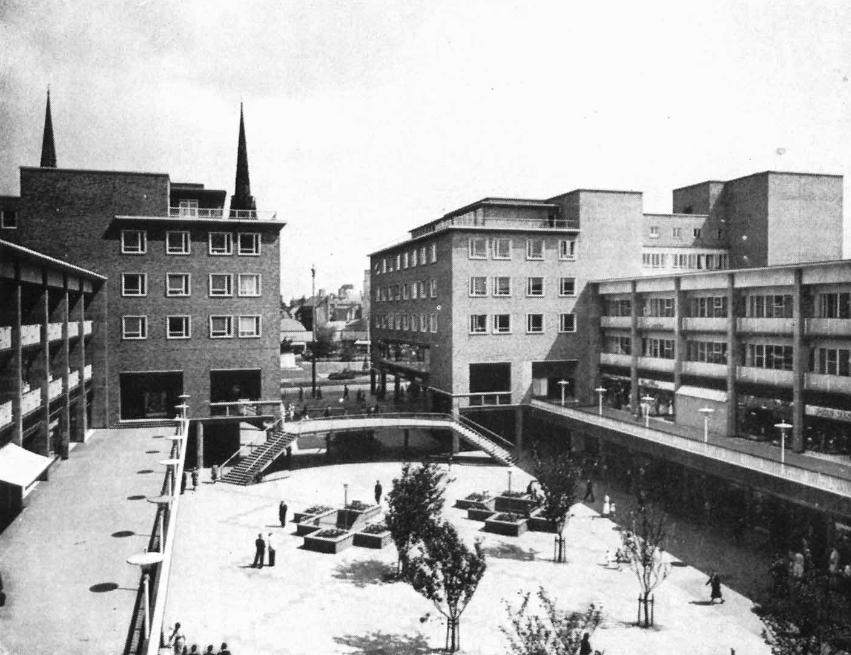
By all accounts these moves are hardly revolutionary. Over the last 15-20 years western cities of all sizes have shunned the automobile in their centres. Large swathes of central Manchester were pedestrianized in the 1980s, with a tram line returning to the city in 1992. Market Street and Piccadilly Gardens in particular have seen sweeping re-developments over the years, attesting to the fact that such moves have been the norm rather than the exception in local urban policy. Chorlton and Wythenshawe likewise saw pedestrianized shopping areas (or ‘precincts’) spring up even earlier in the late 1960s and early 1970s, and Coventry has also had a rather contentious precinct for a similar length of time (see Hubbard and Lilley’s [2004] paper: subscription only). In each the local population is of varying size and demographic. Chorlton is now a sprawling South Manchester suburb, but with arguably a young, white and middle-class core. Wythenshawe lies a little further south and is one of Manchester’s poorest areas. Coventry is a small Midlands city with a large second- and third-generation Caribbean, Indian and Pakistani community. The modernist ideals of a pedestrian shopping core seemingly implanted irrespective of such factors.

So what makes this a particularly noteworthy civic project? Are comparisons to this specific brand of UK post-war urban regeneration profitable? I think the difference lies within how Pontevedra has foregrounded the metrominuto map itself. It gives us an insight into how this project has come to fruition. Manchester does admittedly have a number of sited pedestrian maps, but none make prominent the A-to-B nature of walking like the Pontevedra example. In the same way as mass transit authorities around the world have used Harry Beck’s famous Tube Map design to enhance the utility of fixed rail/track travel, so the city officials have imported these characteristics into a utilitarian walking map. This is where Pontevedra differs to the modern urbanism of Chorlton, Wythenshawe and Coventry. The design speaks for itself. Straight lines are everywhere. Walkers are encouraged to follow the quickest and most direct route. Only the kilometre long riverside walk to the train station is gifted a meandering depiction, complete with lush fields, rounded trees and sky blue water. All routes have unambiguous figures relating to time and distance. 7 minutes to the hospital. 4 minutes to the car park. Perhaps this is why Pontevedra has won an award from Intermodes for what they call ‘the first pedestrian network in Europe’. This isn’t about a distinct shopping area or indeed a single street or junction, but a facilitative network designed to feed into the existing transport system. In this sense, Pontevedra has remarkably different aims: to conceive of the act of walking as a utility.
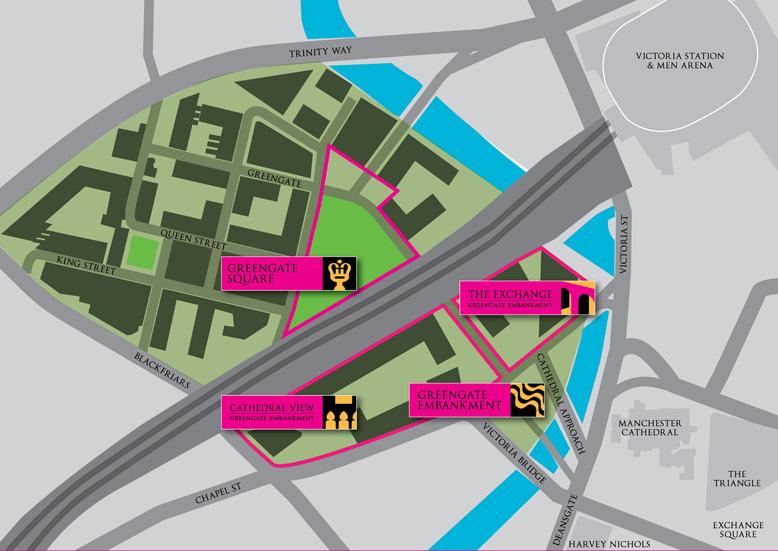
If I am to continue to make connections back to the city of Manchester then the pedestrianization of the Deansgate/Cathedral area perhaps also draws on this bi-pedal inter-connectivity, serving to re-connect the city of Salford with Manchester; a much-maligned area that has nonetheless been trumpeted as an ‘important gateway’ into the city. Terms like ‘touching’, ‘bridging’ and ‘linking’ have all been deployed to characterise this development. Although for many years this has been a vehicular gateway enabling automobile commuters from North Manchester to enter the city rather than anything else. This kind of pedestrianization has more in common with Pontevedra than even the city’s own interpretations over the last 30 years. Salford’s car parks (cheaper than Manchester’s!) should get an ever greater boost as office workers leave their cars on one side of the river and walk over. Its conception is part of a wider transport integration project rather than any narrow consumer boost. The opening of new coffee shops, bars and restaurants is a necessary dimension but not the driving force. Pontevedra, though, seem to have got there first.


 Sam Hind