
Re: the BBC and New Broadcasting House’s supposed ‘open’ newsroom, an NYT column by Evgeny Morozov.
-
Image and Performance Summer school / conference, 8-12 July, Warwick

Further details are available from the Centre for Interdisciplinary Methodologies. Applications are welcome from PhD students, early career researchers and anyone else with a working interest in the field. Please contact Dr. Olga Goriunova to find out more.
-
Newsroom Dynamics
Looks like the BBC are having a few problems with their big move to New Broadcasting House. The irony of designing an open-plan newsroom and then issuing instructions on where and how people move is seemingly lost on them. MediaGuardian have got hold of internal documents outlining some new ground rules, including this little snippet that amused me:
BBC journalists have been briefed on “newsroom etiquette” in preparation for their move and given maps of where they can and cannot stand in their capacious new work place.
And here is the map!
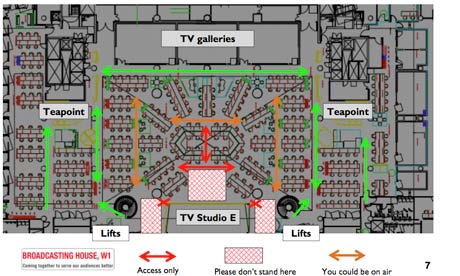
Make sure you don’t stand near the studio windows. Be aware of places where you could be on air, and make “the most of huddle zones, casual chairs, teapoints, meeting rooms.” A great example of how an open architectural ethos actually impedes the everyday nature of news. Sounds like the BBC wants to condition it’s newsroom to show a projected image of how it actually functions, rather than the reality. Maybe because that reality is little less sanitized and smooth that it wants to appear to the general public to be. I thought news-making was meant to be messy, frantic and unpredictable?
Another interesting point I’ve taken from this is that this open ethos has pushed a job previously reserved for architectural and structural features (walls, doors) back onto the individual. Walls and doors serve particular functions. They block, separate and restrict as well as open, shape and dictate. In their absence, inhabitants are forced to self-govern actions. A ‘Please don’t stand here’ sign replaces a wall. A ‘You could be on air’ message replaces a partition. They don’t govern quite as authoritatively as structural features so the BBC’s journalists are forced to internalize these restrictions and govern themselves. Whether it works or not is another issue altogether.
-
Deleuze, Desire, Strategy and Revolution
A two part interview with Andrew Robinson at the New Left Project on Deleuze, desire, political strategy and revolution (Part 1 and Part 2).
A rather handy reading list of some relevant original works (Societies of Control), standalone versions of 1000 Plateaus chapters (Rhizomes, Nomadology), secondary analysis (on utopia, anarchism, fear etc.), and video lectures is at the end of the second part. Although I would add work by Nicholas Tampio and Thomas Nail to the list too.
There’s a section from Galloway’s The Interface Effect (2012) that is more than appropriate to the questions posed to Robinson in the second part. He categorizes the work of Deleuze as combining an ‘aesthetic of coherence with a politics of incoherence’ (p. 49). This is what Galloway calls a poetic regime of signification (or mode of operation). He suggests he elevates the art of philosophy over other concerns. The other concern that Galloway is primarily talking about is politics, political alignment and political strategy. One of the questions Robinson faces is ‘[w]hat is the Deleuzian model of political organization?’ The answer he provides tallies with what Galloway says, that Deleuze’s political mode is incoherent:
Eyal Weizman has written of the ways in which the Israeli Defense Forces have deployed the teachings of Deleuze and Felix Guattari in the field of battle. This speaks not to a corruption of the thought of Deleuze and Guattari but to the very receptivity of the work to a variety of political implementations (that is, to its “incoherence”). (p. 50)
He goes on to suggest that Deleuze’s work is ‘open source’ (p. 50) in the same way open source software does not preclude appropriation. Deleuze’s work does not intrinsically suppose a political project, let alone an emancipatory and progressive one. Moreover, from the other side, that appropriation of rhizomatic concepts, the construction of non-hierarchical formations and other Deleuzian strategies are necessarily automatic paths to freedom. There are theoretical and methodological dangers in supposing either. These are normative judgements on an otherwise non-aligned and incoherent Deleuze.
-
Enter Peatónito, the masked Mexican defender of pedestrians!

Courtesy Peatónito A novel way of enforcing the rights of urban pedestrians in Mexico City over at The Atlantic.
 Sam Hind